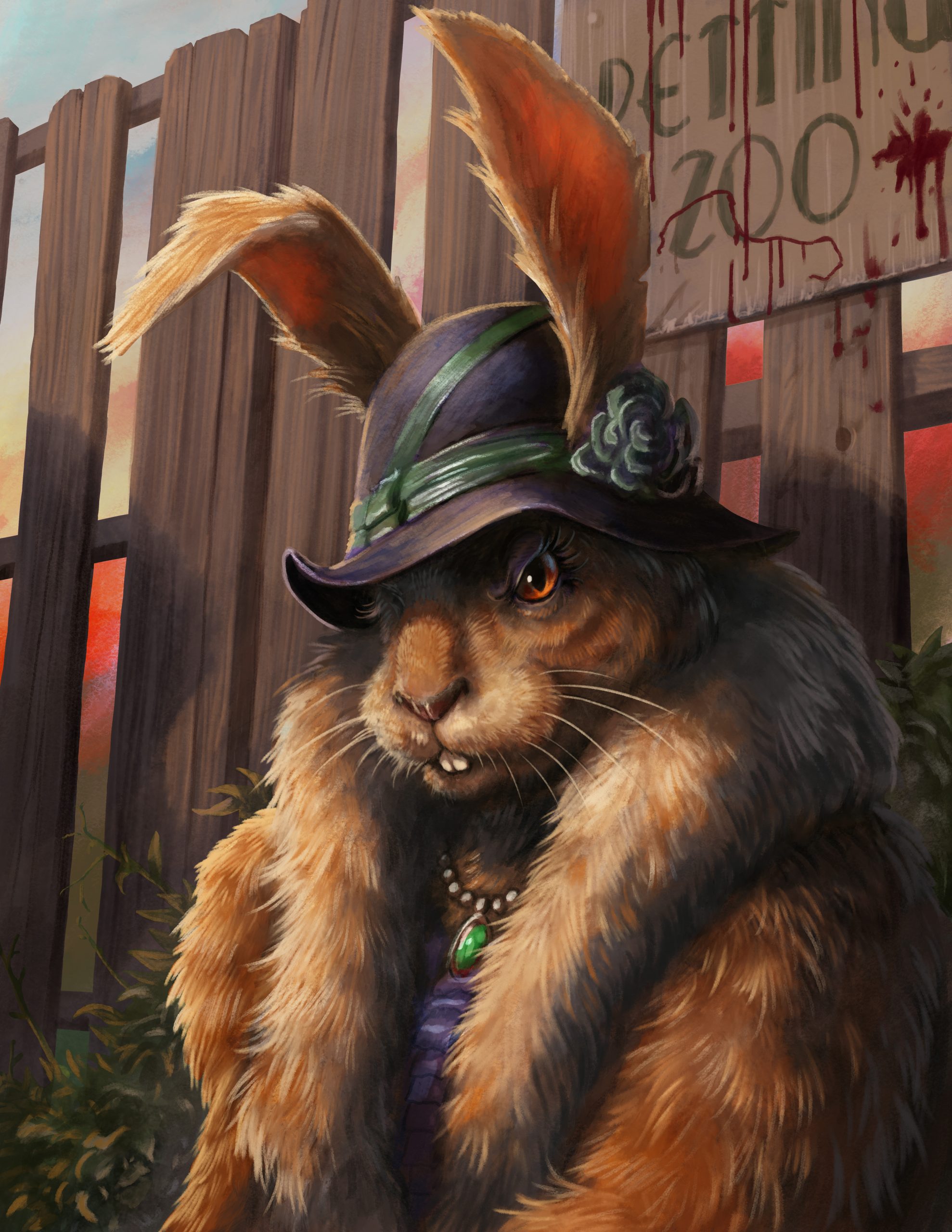

Sugar and Spice and Rolling Fun-Shaped Dice
Some of you may have been following the progress of the Scarlet Sisterhood of Steel and Sorcery game we’ve been playing on YouTube. In that case, you’re probably already aware that it’s become this controversial hot button topic a lot of people seem to be weighing in on, both in the comments and through other media.


Learn How to Play Dungeons & Dragons for Beginners | Brought to you by Easy Roller Dice

What a typical adventuring party might look like … well, actually there is no “typical” adventuring party!
At Nerdarchy we’re excited to announce we’ve recently joined an adventuring party with Easy Roller Dice to do a series focused on teaching new players how to play Dungeons & Dragons. The problem of learning how to play D&D has often been that you need someone to teach you how to play it, an older brother, cousin, or friend of the family who already knew how to play the game! Learning how to play D&D correctly is almost something of a hybrid between written and oral traditions as the complexity of the rules can make it difficult for new players to come into the hobby. That’s how I learned to play — when I was 11 years old, my eldest brother Dave began showing me how to play Dungeons & Dragons in the 2nd edition of the game (and believe me, there were some really awkward, wonky rules — just look up THACO!). Fortunately, we now have the ability to easily share information in written, audio, and visual forms — twenty years ago you needed that mentor player, but now, we can direct you to this series of videos that we’re making for you, apprentice D&D adventurer.


Play Time: RPG Truths Revealed
 On a serious note, were you once a child? Did you spend hours with siblings or friends passing the hours playing with toys, making up games, or obsessing over random strange objects just for the fun of it? “Make believe” was always the term I remember being used to describe these moments outside of reality. As an adult I like to call it “being in the moment” or “living in the now.” As a mother, I gain an incredible amount of inspiration and peace just by watching my two little ones create, and find joy, in the day-to-day moments.


The Name Game Part I: Characters and Groups of People

Drizzt Do’Urden (Photo credit: Wikipedia)
One of the huge problems I see most often, both in players and Dungeon Masters, is naming things. Everything else comes easily, you’ve got a character or an idea and it all comes flooding out, and then you’re left staring at this blank space on the page labeled “name.”
So, I’m going to share some of what works for me when it comes to naming things, and hopefully it will find its way to the hands of someone for whom it will be useful.


Chartopia, Part 3: Complex Tables
 Hello again, friends! In the last article I showed you how Chartopia can be used to create a combat encounter table; I used a sewer adventure as an example. That table works perfectly fine by itself, but sometimes your games require something a little more complex. Let me demonstrate how to make that sewer combat table more intricate.


Chartopia, Part 2: Making Your Own Tables
Hello friends! Last week I shared how Chartopia’s immense random table repository is the perfect source of inspiration for your roleplaying game. Of course, there's always room for more, so why not make your own random table and share it with the community! The "Create Chart"...
Introducing Chartopia
So, you’re a Dungeon Master who’s planned an entire evening of activity for your players. You know they have a quest to go on but to mix things up a bit, you give them an encounter on their travels. A simple skirmish with half a dozen scavenger goblins ought to keep things entertaining. Kill some goblins, get the loot they’d scavenged for themselves, a simple, satisfying encounter…
…only the party didn’t kill the goblins as you’d intended. Not only did they avoid fighting them, they entered a parley with them, bought the loot from them (to re-sell at a profit) and hired the goblins to sell them any other goods they might scavenge. An interesting twist, to be certain, but now you have to come up with six goblin names on the fly to serve as recurring non-player characters.
Now, there’s a few options here. You can just rely on your own imagination, but not everyone is good at coming up with character names, much less six names in an instant. Maybe you have a name generator table that you rely on, but you need to find the book in your stack, find the right page, make multiple dice rolls and collate your information. All the while, your players grow impatient!
Enter Chartopia.
Chartopia is a web-based application designed so that you always have flexibility, inspiration and creativity on-hand during the running of any RPG, despite the unexpected twists your players may make. It provides convenient access to a massive library of random tables to satisfy the needs of any dungeon master, game master or players, all in the palm of your hand. There’s no longer any need to sift through a stack of rule books to find the perfect table.
Why Spell Casters Are Sexy
When first being introduced to DnD you will find a variety of classes that are presented before you and at first what draws attention to you might be something that suits your sexual orientation, masculine or feminine if you will. Most women might be more drawn...

It’s time for a 5th Edition D&D Unearthed Arcana book
[caption id="attachment_14051" align="alignright" width="430"] The original Unearthed Arcana book by Gary Gygax for First Edition Dungeons & Dragons.[/caption] Fifth Edition Dungeons & Dragons has been around for more than a couple of years now. Since its inception, it has been obvious the game’s publisher Wizards of...

Four Reasons We Think You’ll Love Open Legend
 Four Reasons We Think You’ll Love Open Legend
Written by: Ish Stabsoz
We know that RPGs are a dime a dozen, and that you can find a system out there for almost any type of game you want to play – and that’s exactly why we are so honored to have a chance here on Nerdarchy to talk to you about why we think you’ll love Open Legend. In this post, we’ll explore the reasons we created Open Legend and talk about why we’re so excited to share our game with the roleplaying community.
It plays like D&D but with more creative freedom
Open Legend was born out of a frustration with a game that we grew up with, a game that we loved (and still do), but, ultimately, a game that held us back from achieving the stories we wanted to tell. It was in the midst of 4th edition D&D that we began experimenting with the home brewed system that eventually became Open Legend. Our experience with 4e was the same as a lot of hardcore D&D fans: it felt too restrictive.
Obviously, we aren’t trying to bash D&D. It’s a great game for players and GMs who want to tell fantasy stories with recognizable tropes and archetypes. And with the strides that fifth edition has taken, D&D is perhaps the best game to achieve that goal in the industry.

But Open Legend was born out of a desire to let players tell any story at the gaming table that they had read in a book or seen in a movie. We didn’t want restrictions like pre-determined class abilities to prevent players from creating the character they’d always dreamed of seeing in action.
We think you’ll love Open Legend because even though it isn’t D&D, it still plays a lot like the roleplaying game that introduced most of us to the hobby. We love what games like Dungeon World, FATE, and Cypher have done to challenge the expectations of how a roleplaying game feels, but we also realize that not everyone is looking for that sort of paradigm shift. A game of Open Legend still feels a lot like D&D. You still roll for initiative, combat is still conducted turn-by-turn and blow-by-blow, and hit points are still the primary indicator of your character’s health.

Character Progression – Awarding Experience and Rewarding Players
 There are about as many different ways to handle character progression as there are role-playing systems, but most commonly they revolve around one tantalizing resource – experience points. It might go by different names or work differently from system to system, but at the end of a session most players are excited to rack up some XP. Loot and items may come and go, but XP is a permanent reward, one which drives the game forward and works as a proverbial ‘carrot on a stick’ for your players.
So how, as GMs, do we hand out this resource? Some GMs meticulously calculate exactly
how many points each character receives, while others eschew the XP system entirely and
give out levels at narrative milestones. There’s no right or wrong way to handle character
progression, but it is important to make sure that whatever method you’re using is right for
the players in your group, and that everyone’s on board.

Keep track of it all with Digital Character Sheet

Recently I had the opportunity to speak with Nathan Thurston, the creator of Digital Character Sheet, in order to learn about his product. Instead of me telling you about it, I thought I’d let him fill you in. My questions for him are in bold, followed by his answers.
What exactly is Digital Character Sheet?
Digital Character Sheet is software that replaces or supplements a Tabletop RPG player’s character sheet. It was created out of a desire to break away from the sometimes hard to fill, awkward form-fillable PDF character sheets, and provide a more elegant and sensible avenue to store character information.
Tabletop Roleplaying Games – Cypher System by Monte Cook
Tabletop Roleplaying games have been around a while. In the last years many different games have

English: Monte Cook at the 2007 ENnies. (Photo credit: Wikipedia)
been made. Some have fallen and and others have thrived. The hobby of sitting around a table and rolling funny shaped dice is possibly the biggest it has ever been.
Some might say that is because of Monte Cook, and other game designers like him. Nerdarchy had the pleasure of interviewing him just the other night and it was a REAL pleasure to do so. Monte Cook has been designing games since he was in college and, if my math is correct, approaching 30 years, designing in the industry.
The Cypher System is a tabletop roleplaying game built on the back of other games, also made by Monte Cook. Numenera was first and was highly acclaimed for its approach and unique fantasy setting. Next came The Strange. This used the core mechanics from Numenera but offered a new setting and different options for character creation designed for that specific world.
It then occurred to Monte Cook that not everyone wants to play in a specific setting and the core rules that these system used could be expanded upon to make a system that was setting universal and in addition could handle any genre of tabletop roleplaying games.
And so The Cypher System was born. The Cypher System offers things that many other games do not and truly rivals the other games as you can make anything you want.
Major Advantages of the Cypher System
Arcknight: Flat Plastic Miniatures – Gaming options
Many of you out there like to have hordes of options when it comes to visual items to add to your gaming  options. 3d minis comes in several options or styles. Usually you can get pre-painted plastic miniatures but these are usually blind purchase and the cost winds up being around $4-$5 a piece higher if you are going to just grab them off of ebay.
You can go away from the blind purchase and go for the unpainted miniatures. Here you can see exactly what you are getting and wind up paying a better price per mini but if you want them looking good you have to assemble and paint them yourself.
 However what if that those prices or options are not to your liking. Well you could go and grab some cardboard pawns. The flat packing pawns with bases offers smaller storage and usually come in packs so you know what you are getting. Always handy.
I have been in games where these pawns are used and while they are great the paper minis are subject to the hazards of spills. When the excitement is high the chances of something getting knocked over or be subject to pizza fingers.
Here is another option for you. Arcknight offers flat plastic miniatures. These amazing miniatures are printed double sided so that you can actually have a front and back. If you are playing with more realistic rules and need to know which way a character is facing you will have that option. The artwork is really great with loads of character options.
Heroforge – Custom Miniatures for your Tabletop RPG
There is a wide variety of miniature lines out there. D&D and Pathfinder both have their fully painted  ready to go miniatures and for many hero choices they work just fine of you can find a reasonable facsimile. And then you have several other lines that make miniatures including Reaper Miniatures and their Bones line. They are great but they come unpainted and in some cases un-assembled.
For those of you that are unaware Heroforge offers fully customized minis that are 3D printed made to your exact specifications. And they are not limited to designs just for your D&D game. Heroforge offer Custom Miniatures for your tabletop RPGs for fantasy, western, sci-fi, modern and East-Asian themes.
Not only that but you can fully customize it in a way that blends these elements together should your specific character need that. When you go to their site: www.heroforge.com you are presented with a body that you can change the race, make it male or female and dress/equip it with all manner of gear and accessories.
The detail on your choices is amazing. you have the ability to alter on a sliding scale the facial expressions, the muscle tone and every body dimension you might want, height, weight, curves, booty, bust, waist and build. These choices alone make your model more custom than anything else that I have seen.