




What Kind of Campaigns Does Aether Skies Actually Support?
One of the first questions people ask when they hear the premise of Aether Skies is simple:
“What do players actually do in this setting?”
It’s a fair question.
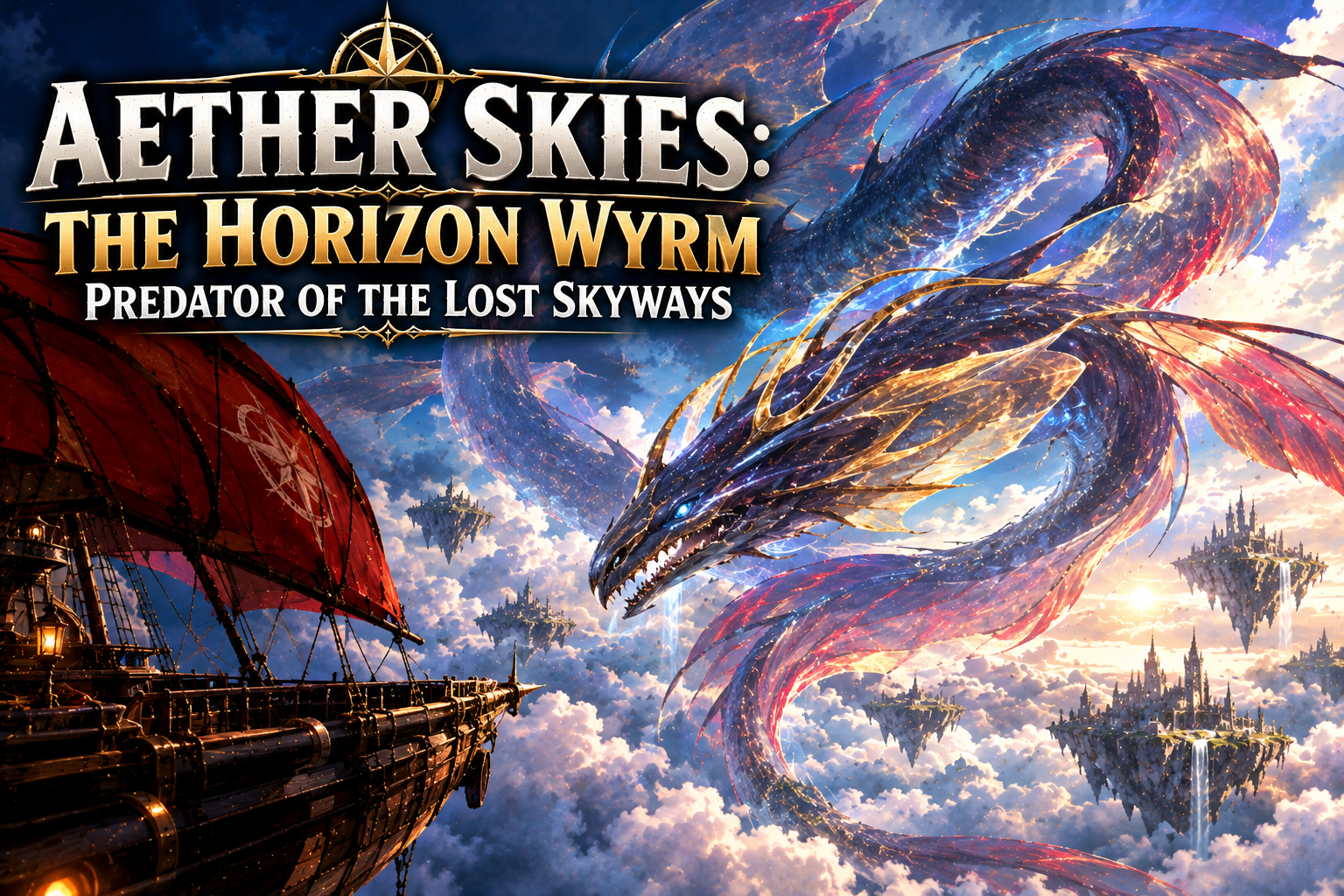
At a glance, Aether Skies looks like a world built for traditional fantasy adventures. Floating cities. Strange technology. Ancient mysteries. Eldritch horrors beyond reality. Surely that means dungeon crawls, monster hunting, and treasure maps hidden in old ruins.
Not exactly.
Aether Skies is not a setting built around wandering from cave to cave killing increasingly dangerous things.
In fact, one of the defining truths of the setting is that direct confrontation is often the worst possible solution.
The world is held together by unstable systems, political tension, fragile alliances, and technologies no one fully understands. The dangers are rarely isolated monsters waiting in rooms for adventurers to kick the door open.
The danger is structural.
It lives in engines. In governments. In storms. In ambition. In information people were never supposed to uncover.
That changes the kind of stories the setting naturally tells.
And honestly?
That’s where Aether Skies becomes interesting.
Political Intrigue Above the Clouds
At its heart, Aether Skies thrives on pressure between powerful cities trying to survive without letting the others gain too much influence.
Every floating city depends on trade, information, and fragile diplomacy. No one can afford open war—not because they are peaceful, but because total conflict could destabilize the systems keeping civilization alive.
That creates a setting perfect for espionage campaigns.
Spies steal research before rival cities can complete dangerous breakthroughs. Saboteurs target supply chains without triggering direct retaliation. Diplomats navigate negotiations where everyone involved is lying professionally. Entire campaigns can revolve around uncovering hidden agendas before political tensions spiral into catastrophe.
This is a world where a forged shipping manifest matters more than a magic sword, and where knowing the right secret can be more powerful than carrying the right weapon.
Players are often trying to prevent escalation rather than defeat a visible enemy. The tension comes from understanding that every choice has political consequences. A successful operation in one city may destabilize another. A hidden alliance may preserve peace while quietly empowering terrible people.
The heroes in these campaigns are investigators, negotiators, double agents, smugglers, informants, and people caught between competing systems trying to survive.
Skyships, Smugglers, and Pirate Campaigns

If intrigue forms one side of Aether Skies, skyships form the other.
The cities may float, but civilization survives because ships continue moving between them. Trade lanes become arteries keeping the world alive, and every captain navigating those routes understands how fragile that system really is.
This makes ship-based campaigns one of the most natural fits for the setting.
A crew aboard a skyship can become merchants, scavengers, privateers, pirates, couriers, bounty hunters, explorers, or all of those things at different times depending on who is paying and how desperate the situation becomes.
The tone can swing between high adventure and survival horror with surprising ease.
One session might involve tense negotiations at a crowded docking platform while rival crews quietly sabotage one another. The next might involve navigating an aether storm while engines fail and impossible shapes move through the clouds outside the hull.
Ship combat also feels different in Aether Skies.
The goal is rarely simple destruction. Ships carry food, medicine, fuel, passengers, and political leverage. Damaging a vessel can create consequences far beyond the battle itself. Boarding actions become desperate and personal because every breach in the hull threatens everyone involved.
Over time, the ship itself becomes part of the campaign’s identity. Players learn its quirks, repair its systems, argue over upgrades, develop rivalries with other captains, and build relationships with recurring ports and crews.
The ship becomes home.
And homes in Aether Skies are always one bad storm away from disaster.
Surface Exploration and Survival
Then there’s the world below the clouds.
Surface campaigns shift the setting into something harsher and far more intimate.
The ground is not a neatly mapped wilderness filled with balanced encounters waiting every few miles. It is a fractured world shaped by corruption, mutation, collapse, and centuries of abandonment.
Survival matters there in ways many fantasy settings rarely emphasize.
Food matters. Shelter matters. Ammunition matters. Weather matters. Trust matters.
Expeditions descend searching for rare resources the sky cities desperately need: lumber, salvage, fertile soil, ancient technology, medicinal plants, or lost archives buried beneath ruins no one fully understands anymore.
And every descent feels dangerous because the surface itself is unstable.
Entire ecosystems evolve unpredictably. Corruption changes living things in inconsistent ways. Ruins continue functioning long after their creators vanished. Some places seem untouched and beautiful until the environment reveals how wrong it truly is.
The tension in these campaigns comes from uncertainty rather than constant combat.
Players are not clearing territory.
They are entering regions civilization stopped understanding generations ago.
Horror Without Constant Battles

This is one of the biggest differences between Aether Skies and more traditional fantasy worlds.
The horror in Aether Skies works best when the unknown remains larger than the players.
Eldritch influence rarely appears as straightforward monsters waiting to be fought. Instead, it manifests through systems failing in impossible ways, memories changing, identities breaking down, dreams spreading between people, or reality itself becoming unreliable.
A district hearing voices no one spoke.
A ship arriving before it departed.
An engine developing habits that resemble emotion.
Citizens remembering contradictory versions of the same event.
These situations create tension because violence cannot easily solve them.
Combat still exists, of course. Pirates raid ships. Surface predators stalk expeditions. Rival factions clash over resources and information. But the deeper problems usually survive the fight.
That distinction changes the tone of the setting dramatically.
The players are often trying to contain damage rather than eliminate evil completely.
Sometimes survival itself becomes the victory condition.
Exploration Instead of Traditional Dungeon Crawling
Aether Skies can absolutely include ruins, abandoned facilities, forgotten laboratories, and ancient structures.
But they rarely function like traditional dungeons.
Ruins in Aether Skies are usually remnants of failed systems rather than isolated treasure vaults filled with disconnected encounters. Exploration becomes investigative instead of procedural.
Players enter these places trying to understand:
What happened here?
Why was it abandoned?
What went wrong?
Could it happen again?
An ancient facility may still be operational after centuries, but its systems no longer behave according to recognizable logic. Security mechanisms may respond to outdated authority structures. Records may contradict one another. Entire sections of the structure may feel physically wrong.
The danger comes from unraveling something humanity was never supposed to rediscover.
That same philosophy applies to wilderness exploration.
The setting is less interested in random encounters for the sake of attrition and more interested in sustained environmental pressure. Storms, corruption, isolation, mechanical failure, and dwindling supplies create far more tension than endless wandering monsters.
A Setting Built on Pressure
More than anything else, Aether Skies thrives on pressure.
Political pressure. Environmental pressure. Social pressure. Psychological pressure.
The best campaigns usually involve multiple systems straining at once. Cities compete for dwindling resources while storms worsen. Dangerous research continues because civilization depends on technological progress. Smugglers move illegal cargo because entire districts would starve without black market supply lines.
Even moments of peace should feel temporary.
Not hopeless.
Just fragile.
That fragility is the soul of the setting.
Because Aether Skies is not really about conquering the world.
It is about holding it together.
The heroes are not always legendary warriors destined to slay ancient evils. More often they are repair crews trying to stabilize failing systems. Captains transporting medicine through storm lanes. Diplomats preventing cities from collapsing into open conflict. Explorers risking their lives to recover resources civilization cannot survive without.
They are people trying to preserve one more piece of the world before it falls apart.
And in Aether Skies, that is what makes someone heroic.
Thanks for reading. Until Next Time, Stay Nerdy!!


No Comments