




Under the Dome: The Krynnathi — The Grindshapers
“We chew the storms and spit out order.”
The world beyond the Domes is a dangerous place. Chaos Storms reshape the landscape, Grind contaminates the ground, and creatures adapt to survive conditions that would destroy ordinary life. Some people fear Grind. Others seek to control it. The Krynnathi have developed a very different relationship with the substance. They eat it.
Known as the Grindshapers, the Krynnathi are an insectoid people whose bodies can consume raw Grind, refine it internally, and transform it into crystalline materials. Through specialized organs and remarkable biological crafting abilities, they produce weapons,  armor, tools, and structures from the very substance that makes the world so dangerous.
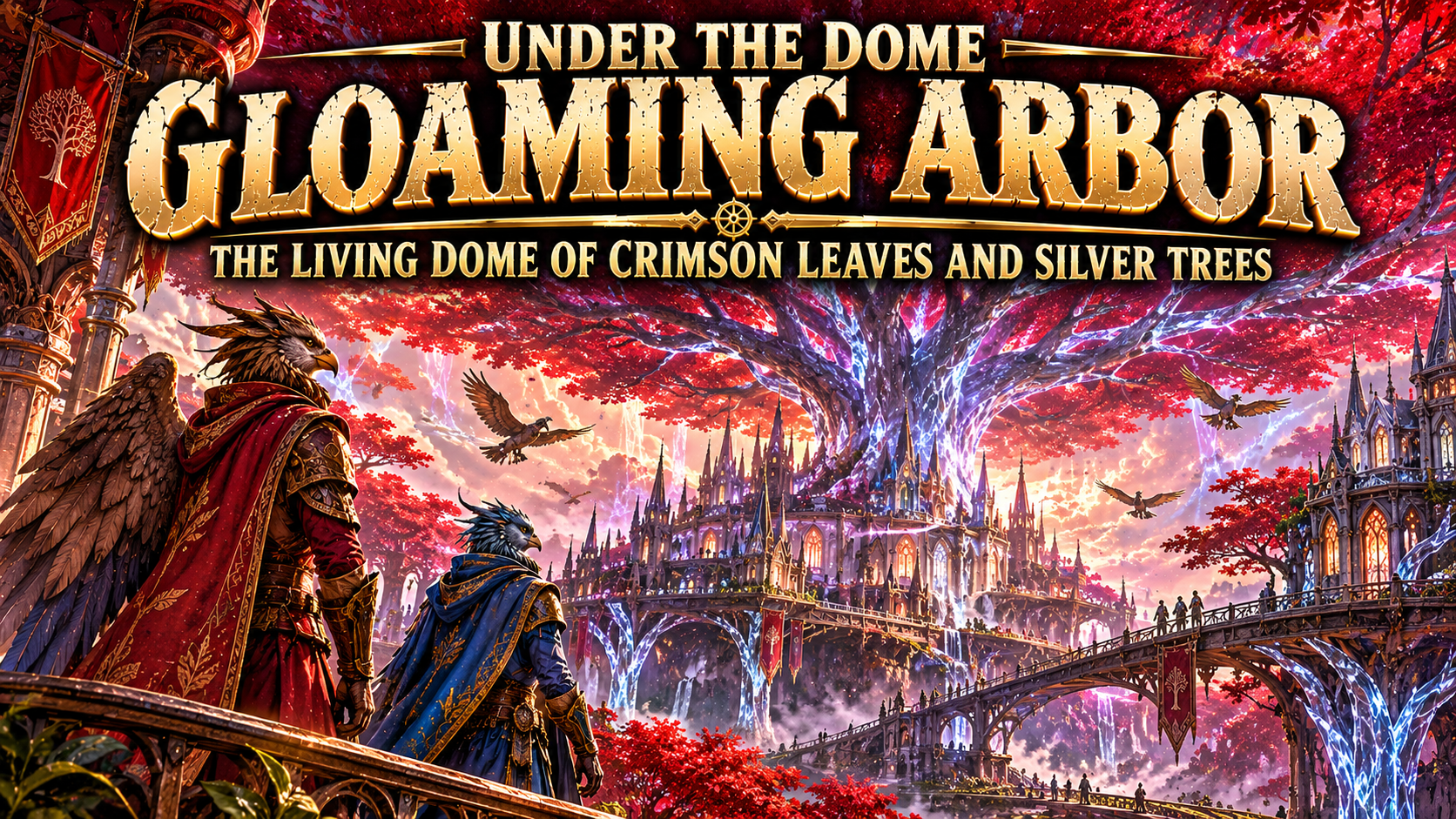
They are not simply another insectoid species surviving in the wasteland. They are a people whose biology, culture, and technology have evolved around Grind. Their bodies are workshops, their clans are communities of artisans and warriors, and their relationship with the chaotic world around them is unlike anything found among the other peoples of Under the Dome. Last week we looked at the newest Dome in our expanding series: Gloaming Arbor, but we need to dive into one of the many threats against these domes.
The Origins of the Krynnathi
Nobody knows exactly where the Krynnathi came from. Some scholars believe they evolved in regions where Grind was abundant, while others argue that their ancestors lived in the ruins of fallen Domes or within the long-term aftermath of Chaos Storms. There are even theories that the Krynnathi are the result of an ancient experiment intended to create organisms capable of processing Grind safely.
The Krynnathi themselves have their own stories. Some clans claim their ancestors emerged from the first great Grind deposits, while others tell of a Shard Queen who led her brood through a storm and taught them to consume the substance rather than fear it. Their oldest traditions describe a time when their people had no crystalline craft and survived by scavenging the weapons and tools of other species.
Whatever their origin, the Krynnathi have become remarkably well adapted to the world of Under the Dome. Their internal biology allows them to process raw Grind, separating useful material from dangerous impurities and transforming it into a crystalline substance they can shape and use.
This ability makes them valuable, dangerous, and frequently misunderstood. Other peoples see Grind as a resource to mine, refine, trade, or weaponize. The Krynnathi see it as something they can make part of themselves.
Appearance and Physiology
The Krynnathi are insectoid humanoids, but their appearance varies considerably between clans and biological strains. Their bodies are protected by chitinous plates, their eyes are often multifaceted, and their limbs may be adapted for climbing, digging, gliding, or combat. Some have long, mantis-like arms, while others possess thick beetle-like armor or delicate wings that catch the air.
Their most distinctive features are connected to their ability to process Grind. Beneath their primary mouths, Krynnathi possess specialized grinding mandibles. These secondary mouthparts break down raw Grind and prepare it for processing by an internal organ sometimes called the Grindheart. This organ refines the material into a stable crystalline substance that can be expelled through specialized salivary crafting glands.
The resulting resin hardens quickly when exposed to air. A Krynnathi can manipulate it with their mouthparts, hands, and specialized appendages, shaping it into useful objects before it becomes solid. Experienced individuals can produce surprisingly intricate designs, from balanced weapons to complex tools and protective plating.
Grind exposure also leaves visible marks. Many Krynnathi display glowing lines beneath their chitin, bioluminescent eyes, crystalline growths, or scars that shimmer with strange energy. The appearance of these features often reflects a Krynnathi’s history, clan, and experience with Grind.
Their bodies are not uniform, however. Different strains have developed specialized traits, and those differences influence both their roles in society and the way outsiders perceive them.
Krynnathi Culture: Clans, Broods, and Shard Queens
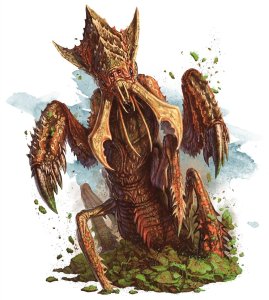
Insectoid monsters are just straight up creepy and terrifying, like the ankheg as seen in the fifth edition Dungeons & Dragons Monster Manual. [Image courtesy Wizards of the Coast]
A Krynnathi clan is more than a family or military organization. It is a community built around a shared resource and a shared understanding of Grind. Its members work together to protect their source, develop their craft, and ensure the next generation has the knowledge and materials needed to survive.
The clans do not agree on what Grind means. Some regard it as a gift from the world, a substance that should be respected and used carefully. Others see it as fuel, a resource to be consumed and converted into strength. A few believe that the greatest Krynnathi are those who can endure the largest quantities of Grind and emerge changed by the experience.
These competing philosophies have created tensions between clans. A group that carefully manages its Grind deposits might consider another clan reckless and destructive. A clan that prizes experimentation could view traditionalists as stagnant and unwilling to evolve.
The most dangerous are those who consume too much Grind. These Krynnathi are known as the Shardbroken. Their bodies become unstable, their crystalline growths spread unpredictably, and their minds may be overwhelmed by the chaotic energy they have absorbed. Some become powerful but unpredictable warriors. Others lose the ability to distinguish their own desires from the strange impulses of the Grind.
The Shardbroken are not necessarily exiled from every clan, but they are feared. Some clans consider them tragic victims who deserve protection, while others see them as a threat that must be destroyed before their instability spreads.
Grindshaping: A Craft Born Within the Body
The ability to transform Grind into crystalline material is the defining trait of the Krynnathi. Their Grindhearts process the substance, while their crafting glands produce the resin used to bind and shape it. This gives them a unique form of biological craftsmanship.
A Krynnathi does not need a forge, a workshop, or a collection of specialized tools to create a simple weapon. They need Grind, time, and the knowledge of how to shape the resulting material. Their creations are not necessarily crude or primitive. Experienced Grindshapers can produce elegant, balanced objects with intricate patterns and specialized properties.
Each Krynnathi is traditionally expected to create a personal shard-weapon. This weapon is more than equipment. It is an expression of identity, experience, and skill. As the Krynnathi grows, the weapon can be reshaped, reinforced, or altered to reflect its owner’s development.
Some Krynnathi carry the same weapon for their entire lives, adding new layers and modifications as they gain experience. Others regularly break down and remake their creations, believing that a weapon should never stop changing.
Their crafting abilities extend beyond weapons. Krynnathi can produce shields, armor plates, climbing implements, mining tools, and temporary structures. A clan with enough time and access to Grind can create barriers, reinforce a settlement, or construct defenses that would take other peoples considerably longer to manufacture.
This makes the Krynnathi valuable allies to miners, mercenary companies, and settlements operating in dangerous regions. It also makes them targets for anyone hoping to acquire their techniques or exploit their biology.
The Four Krynnathi Castes

Although all Krynnathi share the ability to process Grind, different strains have developed distinct physical adaptations. These variations are commonly described as castes, though not every clan uses the same terminology or assigns the same social importance to them.
The Glassmandibles are the warrior strain. Their bodies are heavily armored, their mandibles are powerful, and their limbs are adapted for close combat. They can produce dense crystalline weapons and reinforce their natural armor with temporary plating. Glassmandibles commonly serve as clan guardians, elite hunters, and enforcers. Some become mercenaries, offering their combat abilities to settlements and factions in exchange for Grind or other resources.
The Skystalkers are the gliding strain. Their lightweight bodies and wing-like membranes allow them to glide between elevated locations and remain airborne for limited periods. They are excellent scouts, messengers, and aerial hunters. In regions with tall cliffs, ruined structures, or massive natural formations, Skystalkers can travel routes that would be inaccessible to other Krynnathi. Some clans use them to monitor distant Grind deposits or watch for approaching threats.
The Shardminds are the mystic strain. Their internal Grind-processing systems have developed a connection to psychic resonance, possibly as a result of generations spent near Mindstorm activity. Shardminds are often capable of limited telepathy and unusual mental abilities. Some can create minor illusions or manifest psionic effects, though the nature and strength of these abilities vary. They are frequently respected as lorekeepers, ritual specialists, and interpreters of strange Grind phenomena. Other clans sometimes distrust them, particularly when their abilities develop in unpredictable ways.
The Stonechewers are the heavy worker strain. Their bodies are bulky, their mandibles are powerful, and their internal systems are especially effective at processing dense materials. They can produce substantial quantities of crystalline resin and are often responsible for mining, construction, and maintaining clan defenses. Some Stonechewers become skilled artisans and engineers, while others use their strength and crafting abilities to create siege equipment and heavy armor.
These castes are not rigid occupations. A Glassmandible might become a scholar, a Stonechewer might serve as a scout, and a Shardmind might become a formidable warrior. Krynnathi culture recognizes the value of specialization, but individual talent and accomplishment still matter.
A Personal Shard-Weapon
One of the most interesting aspects of Krynnathi culture is the creation of a personal shard-weapon. Every young Krynnathi is encouraged to develop a weapon suited to their body, fighting style, and personality. The process is part practical training and part rite of passage.
A Krynnathi might create a curved blade that resembles a mantis forelimb, a heavy crystalline club, a set of throwing shards, or a flexible weapon made from layered resin. The weapon is not simply produced and forgotten. Its owner learns how to reshape it, repair it, and improve it over time.
This tradition also offers an opportunity to make Krynnathi characters distinctive in play. Rather than carrying an ordinary weapon purchased from a merchant, a Krynnathi adventurer might have a personal creation that changes as the character advances. A weapon might gain new shapes, develop unusual properties, or become a symbol recognized by members of the character’s clan.
For player characters, Grindshaping can be represented with a simple ability. Once per long rest, a Krynnathi can consume one unit of Grind to create a temporary weapon, shield, or tool made from chaos-crystal. The object lasts for eight hours or until it is broken. More advanced characters might learn to produce throwing shards, crystalline traps, or reactive armor plating through feats or subclass features.
Rare Krynnathi can even shape spell focuses or weapons capable of holding minor magical properties. These creations are highly valued, and some clans consider the ability to produce them evidence of exceptional mastery.
The important distinction is that Grindshaping is not ordinary crafting. It is a biological process, and the Krynnathi are the only people known to perform it this way.
The Krynnathi and the Other Peoples of Under the Dome
The Krynnathi occupy an unusual position among the peoples of Under the Dome. Their ability to process Grind makes them valuable, but their clan loyalties and fierce protection of their resources make them difficult to control.
In the Black Sands surrounding Balaria, Krynnathi clans sometimes establish themselves near mineral-rich canyons and hidden Grind deposits. Their presence can complicate mining operations, particularly when outsiders begin extracting resources from territory claimed by a clan. Balarium miners might view the Krynnathi as dangerous competitors, while the Krynnathi see the miners as intruders who do not understand the value of what they are taking.
Some clans trade with settlements, exchanging crystalline tools, weapons, and crafted materials for food, technology, information, or preserved biomass. Others work as mercenaries and hunters, using their specialized abilities to earn access to resources they cannot easily obtain themselves.
Their relationship with the Fleshwarpers is particularly interesting. Both groups are fascinated by the possibilities of altering living bodies, but their approaches are very different. Fleshwarpers manipulate biological structures through experimentation and modification, while the Krynnathi have evolved a natural process for transforming Grind into usable material. Cooperation between the two could lead to extraordinary breakthroughs. It could also produce terrible mistakes.
There are rumors of Krynnathi clans experimenting with Fleshwarper techniques, attempting to create new castes or improve their Grindhearts. Whether these efforts represent the next stage of Krynnathi evolution or the beginning of another Shardbroken catastrophe remains to be seen.
The Krynnathi and Gloaming Arbor
The Krynnathi have a particularly troubling history with Gloaming Arbor. The living Dome’s silver crystal trees contain amber-rich material that attracts certain Krynnathi clans. To them, the amber is more than a valuable resource. It may contain properties that can be consumed, refined, and incorporated into their crystalline craft.
This has brought them into conflict with the Rootwardens and the Verdant Folk. The Krynnathi see the silver trees as a source of rare material, while the people of Gloaming Arbor regard them as living parts of their home. What one side considers harvesting, the other sees as an attack on the Dome itself.
Some Krynnathi clans have attempted to negotiate access to fallen branches and naturally shed material. Others have tried to breach the living canopy and take what they need by force. The Rootwardens do not make much distinction between the two when a tree is damaged.
The conflict becomes even more complicated when considering the events of the Blighted Bough. The Chaos Storm fragment discovered beneath the crimson canopy demonstrated that the living Dome is not immune to outside influence. Could the Krynnathi have been drawn to the amber because they sensed something unusual within it? Could their ability to process Grind make them uniquely capable of understanding or containing the corruption?
Or is there a clan that knows far more about the fragment than it is willing to admit?
The Krynnathi do not need to be villains in this conflict. A clan might be seeking a way to protect its people from a growing threat, even if its methods put Gloaming Arbor at risk. Another might see the living Dome as an opportunity to acquire a resource unlike anything it has encountered before.
Either way, the Krynnathi bring a new kind of tension to Gloaming Arbor, one rooted in competing ideas about survival, ownership, and the value of the natural world.
Using the Krynnathi in Your Under the Dome Campaign

The Krynnathi offer plenty of possibilities for Game Masters. They can be encountered as isolated hunters, members of a traveling trade clan, mercenaries hired by a Grind Baron, or an organized force protecting a valuable deposit. Their appearance does not automatically mean combat. A Krynnathi clan might be willing to trade, negotiate, or offer assistance if the characters respect its territory and understand its relationship with Grind.
A group of characters might be hired to negotiate with a Shard Queen whose clan has blocked access to a valuable Grind vein. The miners insist the deposit is unclaimed, but the Krynnathi have been harvesting it for generations. The party must decide whether to support the miners, respect the clan’s claim, or find another solution.
A different adventure could begin when a Krynnathi brood starts consuming too much Grind. Its members are becoming unstable, and the Shard Queen has begun transforming into something monstrous. The clan needs help, but its leaders refuse to admit that their own traditions may have contributed to the crisis.
A clan might offer the characters a rare, stable Grind crystal in exchange for recovering an object from a sealed Fleshstorm ruin. The Krynnathi insist the object is necessary to protect their people, but the characters discover that it may be connected to the experiments that created the Fleshwarpers.
There could also be open conflict between Fleshforged creations and Krynnathi shardcrafters. Both sides are attempting to claim the same territory, and their escalating battles threaten to destabilize a neutral settlement. The characters might be asked to negotiate peace, sabotage one side’s production, or discover who is secretly encouraging the conflict.
Finally, a Krynnathi Shardmind could approach the characters with a disturbing warning. Its psychic abilities have begun receiving impressions from the Chaos Storms, and it believes something is communicating through the Grind. The messages are fragmented, but one phrase keeps repeating: the Domes are not the only things being shaped.
The Grindshapers Are More Than Their Craft
The Krynnathi bring something unique to Under the Dome. They are not simply another people trying to survive the aftermath of the Chaos Storms. They have adapted to the world’s most dangerous substance and made it part of their bodies, culture, and identity.
Their clans provide opportunities for alliances, rivalries, trade, and conflict. Their castes offer distinct character concepts, while Grindshaping gives them a recognizable identity that goes beyond their insectoid appearance. Their relationship with the Grind also raises questions about what happens when a people becomes dependent on the very force that has reshaped their world.
Are the Krynnathi the next stage of life in a world transformed by Chaos? Are they simply another species that found a way to survive? Or are they changing into something even the Domes were never designed to contain?
In Under the Dome, survival means adaptation. The Krynnathi have taken that lesson further than most.
Thanks for reading. Until Next Time, Stay Nerdy!!



No Comments