




D&D Monster Lore Deep Dive – The Aboleth
Aboleths Remember the Dawn of Time: The Most Terrifying Memory in D&D Lore
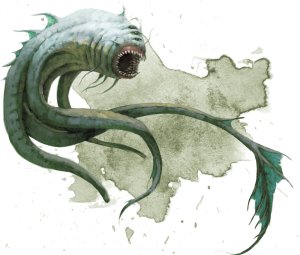
An aboleth as seen in the fifth edition Dungeons & Dragons Monster Manual. [Image courtesy WIzards of the Coast]
Dragons remember fallen kingdoms. Liches preserve forbidden knowledge. Even elves can recall events that occurred centuries before a human civilization was founded.
Aboleths operate on an entirely different scale.
According to official D&D lore, aboleths possess perfect ancestral memory. Every aboleth alive today remembers everything every aboleth has ever experienced. Their memories stretch backward through countless generations without gaps, omissions, or distortions.
That means an aboleth does not study history.
It remembers it.
Welcome back to Monster Lore Deep Dive, where we examine official monster lore not as collections of abilities and statistics, but as storytelling tools capable of reshaping entire campaigns.
Few monsters demonstrate that idea better than the aboleth.
Aboleths Possess Perfect Genetic Memory
The Monster Manual and Lords of Madness describe aboleths as possessing a form of inherited memory unlike anything else in D&D. Every experience of every previous aboleth becomes part of the consciousness of every new aboleth born into the world.
To an aboleth, there is no meaningful difference between personal memory and recorded history.
If an aboleth empire ruled the oceans ten thousand years ago, every living aboleth remembers standing in those cities. If an ancient war devastated the world before mortal civilizations existed, every aboleth remembers watching it happen.
The implications become even stranger when the lore explains just how far back those memories reach.
Aboleths remember a time before the gods ruled the world.
Some sources strongly imply they remember a time before many gods existed at all.
From an aboleth’s perspective, divine beings are not eternal creators worthy of worship. They are newcomers who arrived late, seized control of reality, and rewrote history in their favor.

I love monsters, and this really makes me look forward to an aboleth adventure.
Whether that perspective is true hardly matters.
The aboleths believe it completely because, from their point of view, they were there.
The World Was Once Theirs
This changes the way an aboleth views every living creature it encounters.
To mortals, kingdoms rise and fall over centuries. Religions endure for millennia and feel permanent. Entire civilizations vanish and become legends.
An aboleth measures time differently.
It remembers continents with different coastlines. It remembers species that no longer exist. It remembers civilizations that disappeared so completely that not even their ruins remain. Empires that dominate the current age appear temporary and insignificant compared to the endless procession of history the aboleth carries in its mind.
Most importantly, it remembers losing.
That loss defines the species.
Aboleths do not view themselves as conquerors seeking new territory. They see themselves as rightful rulers reclaiming a world stolen from them by younger races and younger gods.
From that perspective, mortals are squatters living among the ruins of someone else’s inheritance.
Playing Aboleths as Ancient Witnesses
One of the biggest mistakes Dungeon Masters make with aboleths is portraying them as angry monsters ranting about revenge.
Anger implies urgency.
Aboleths have existed long enough to see urgency become irrelevant.
An aboleth should feel patient, composed, and almost impossibly old. It doesn’t need to threaten adventurers because it has already watched civilizations larger than theirs vanish into history. It knows kingdoms disappear. It knows religions fracture. It knows heroes become forgotten names carved into weathered stone.
When an aboleth speaks, it should sound less like a villain and more like a historian explaining inevitable truths.
Imagine an aboleth calmly telling a cleric that it remembers when their god first claimed dominion over a particular aspect of existence. Imagine it describing forgotten divine wars that contradict modern scripture or casually mentioning that the ocean floor beneath the party once housed a civilization whose name has been erased from every mortal language.
The horror comes from certainty.
The creature isn’t making predictions.
It’s making comparisons.
Knowledge as a Weapon

Aboleths become far more frightening when their greatest threat isn’t their tentacles or psychic abilities.
It’s what they know.
An aboleth should possess information it has no reasonable way of learning. It might know the true name of a forgotten deity, understand the origin of a sacred artifact, or reveal details about a kingdom’s future by describing identical patterns that played out thousands of years earlier.
This transforms conversations with an aboleth into encounters every bit as dangerous as combat.
Players may discover that their religion omitted uncomfortable truths. They may learn that a celebrated hero was manipulated by forces they never understood. Entire worldviews can begin to unravel under the weight of knowledge that predates recorded history.
The aboleth doesn’t need to dominate minds if it can destabilize beliefs.
Why Aboleths Make Exceptional Cosmic Horror
Many D&D monsters threaten characters physically.
Aboleths threaten certainty itself.
They challenge the assumption that history is complete, that the gods are unquestionable authorities, and that the current age represents progress rather than merely another temporary chapter in an endless cycle of rise and collapse.
Cosmic horror works best when it forces characters to confront truths larger than themselves.
Aboleths embody that idea perfectly.
They are living reminders that the world existed long before mortals arrived and may look very different long after mortals are gone.
The truly unsettling part is that they remember every moment of it.
The Horror of Being Right
What makes aboleths so compelling isn’t the possibility that they’re lying.
It’s the possibility that they’re telling the truth.
Maybe the gods really were conquerors.
Maybe history really was rewritten.
Maybe the world does belong to someone else.
An aboleth won’t try to convince you.
It doesn’t need to.
As far as it’s concerned, history already decided the argument long ago.
It simply remembers the answer.
Sources: Monster Manual (5th Edition), Aboleth; Lords of Madness (3.5 Edition), pages 8-11.
Thanks for reading.
Until next time, stay nerdy.

No Comments