




Villain Playbook: The False Prophet — Creating a Memorable D&D Villain
The most dangerous person in a kingdom isn’t always the person sitting on the throne.
Sometimes it’s the person standing in front of the throne telling everyone what happens next.
The False Prophet doesn’t need an army. They don’t need a fortress. They don’t even need to be particularly powerful.
They need people to believe them.
After the Fallen Paladin D&D Villain Playbook, we’ve already looked at what happens when someone loses faith in the ideals that once guided them. The False Prophet takes that idea in a different direction. Instead of losing faith, they weaponize it.
They claim to know what the gods want.
They claim to have seen the future.
They claim that disaster is coming.
And, perhaps most importantly, they have an explanation for why it is happening.
The problem is that some of their predictions might actually come true.
What Is the False Prophet Villain Archetype?
The False Prophet is a villain who gains power by claiming access to divine knowledge, prophecy, visions, or some other source of supernatural truth.
They might be a charismatic cult leader, a fraudulent priest, a self-proclaimed oracle, a respected religious figure, or even a seemingly ordinary person who suddenly begins announcing visions.
The important part isn’t whether they actually possess supernatural abilities.
The important part is that other people believe they do.
That belief can become incredibly powerful.
A False Prophet might predict that a plague will strike the city. Then someone gets sick.
They announce that a great hero will arrive. Days later, an adventuring party enters town.
They claim the king will die before the next moon. Suddenly, every assassin in the kingdom has a reason to act.
The prophecy doesn’t even have to be real to become true.
That is where this villain becomes especially dangerous.
Why the False Prophet Makes a Great D&D Villain
Prophecy creates uncertainty.
Players are used to solving problems by gathering information. They find clues, investigate locations, question witnesses, and eventually discover the truth.
The False Prophet makes information itself the battlefield.
What if the prophecy everyone is talking about is real?
What if it is completely fabricated?
What if it started as a lie but became true because people believed it?
What if the gods really are speaking to the False Prophet, but the villain is deliberately twisting the message?
These questions can keep a party engaged long before initiative is ever rolled.
The False Prophet also gives the DM a chance to make the entire world react to the villain.
A powerful monster might threaten a village.
A False Prophet can change what that village believes.
Farmers abandon their fields because they believe a drought is coming. Nobles begin hoarding food. Soldiers refuse to fight because they believe the battle has already been foretold.
The villain doesn’t need to control anyone directly.
They simply convince everyone that their actions are inevitable.
How to Introduce a False Prophet in Your Campaign

The best way to introduce this villain is through their followers.
Don’t start with the villain.
Start with the consequences of believing them.
The heroes might arrive in a town where nobody will leave their homes after sunset because the Prophet predicted that something terrible will happen.
Perhaps shops are closed because everyone is preparing for the end.
Maybe families are giving away their possessions.
Perhaps hundreds of people are gathering outside a temple waiting for the fulfillment of a prophecy.
The party might initially assume that some supernatural disaster is responsible.
Then they hear the name of the person who predicted it.
The Prophet.
The interesting part is that the locals aren’t necessarily foolish.
They might have perfectly reasonable reasons for believing.
The Prophet predicted the last storm.
They warned everyone about a monster attack.
They knew about the death of a noble before the news arrived.
They even predicted that the adventurers themselves would come to town.
Suddenly, the heroes have a problem.
How do you convince someone that a person who has repeatedly been right is lying?
The Prophecy Should Be Vague Enough to Be Dangerous
One of the most useful tools for running a False Prophet is ambiguity.
A prophecy shouldn’t explain everything.
It should give people just enough information to interpret events however they want.
“The red moon will bring death to the city.”
That’s enough to cause panic.
Does the red moon mean an actual celestial event?
Does “death” mean someone important will die?
Does “the city” mean the entire settlement or just the royal family?
Could the prophecy be referring to a literal red moon?
Or is the red moon the name of an assassin?
Now everyone is looking for evidence that confirms what they already believe.
This also lets you play with expectations.
The heroes might spend half a campaign trying to prevent a prophecy from happening only to discover that they misunderstood it.
Or the False Prophet may have deliberately constructed the prophecy so that almost any outcome can be interpreted as proof.
The False Prophet Doesn’t Have to Be Lying

This is where the archetype gets really interesting.
What if the False Prophet actually receives visions?
They aren’t necessarily inventing everything.
Perhaps a god sends them visions, but the Prophet has started manipulating those visions for their own purposes.
Maybe the visions come from an ancient magical artifact.
Perhaps they’re receiving messages from a celestial being that has its own agenda.
Maybe the Prophet can genuinely see the future, but only fragments of it.
Or perhaps their ability is completely real and their interpretation is completely wrong.
That last option can be particularly compelling.
The villain might sincerely believe they are saving the world.
They’ve seen something terrible coming.
They believe the only way to prevent it is to unite humanity under their leadership, eliminate certain people, or sacrifice an entire kingdom.
The party may eventually discover that the vision was real.
The interpretation wasn’t.
Now the heroes have to convince someone who has actually seen the future that they misunderstood what they saw.
When the Prophecy Starts Coming True
The False Prophet becomes much more dangerous when the players discover that some of the predictions are accurate.
Don’t make every prophecy true.
That removes the mystery.
Instead, let the villain get things right often enough to make everyone uncomfortable.
Maybe they predicted a noble’s death.
They were right.
They predicted a monster attack.
They were right.
They predicted that a member of the adventuring party would betray someone.
Now the players are paying attention.
The trick is making sure there is an explanation for these predictions.
Maybe the Prophet arranged the noble’s assassination.
Maybe they hired the monsters.
Maybe they manipulated the adventurers into making the choice they predicted.
The Prophet isn’t necessarily seeing the future.
They’re creating it.
That can be one of the most satisfying reveals in the entire campaign.
Running the False Prophet Beyond Combat
A False Prophet should rarely feel like a villain who simply waits in a dungeon.
Their real battlefield is society.
Let the players hear sermons about them.
Let NPCs argue about their predictions.
Have merchants change their prices because of an upcoming prophecy.
Have nobles make political decisions based on what the Prophet supposedly knows.
Have parents name their children after figures mentioned in the prophecy.
Let the players encounter people who genuinely believe the Prophet saved their lives.
This makes the villain feel powerful without giving them absurd combat abilities.
The heroes may defeat the Prophet in a fight and still lose.
The followers might continue spreading the message.
The prophecy might continue circulating.
The political movement created around the Prophet might survive their death.
That gives the villain consequences beyond hit points.
The Prophet’s Greatest Weapon Is Certainty

The False Prophet doesn’t need everyone to understand the truth.
They just need everyone to believe that they do.
They speak with absolute confidence.
They don’t hesitate.
They don’t say, “I think this might happen.”
They say, “This will happen.”
That confidence is contagious.
When the world is frightening and uncertain, people want someone who sounds certain.
This is especially effective during a crisis.
After a war.
During a plague.
After a natural disaster.
When monsters are appearing more frequently.
When the gods seem silent.
The worse the world becomes, the easier it is for someone promising answers to gain followers.
Give the Players a Reason to Doubt Their Own Assumptions
A good False Prophet can even turn the players’ own knowledge against them.
Suppose the party learns that the Prophet predicted their arrival.
Now every strange thing that happens might seem connected to that prediction.
An NPC says something suspicious.
A monster appears.
A party member has a strange dream.
A door opens by itself.
Suddenly the players are wondering whether the Prophet knows more than they do.
You don’t need to constantly confirm the prophecy.
In fact, uncertainty is more useful.
Let the players debate what it means.
Let them form theories.
Let different NPCs have completely different interpretations.
The goal isn’t necessarily to fool the players.
It’s to make them wonder.
The Moment the False Prophet Is Exposed
Eventually, the heroes should have the opportunity to challenge the Prophet’s credibility.
Maybe they discover that one of the famous predictions was written after the event happened.
Maybe they find evidence that the Prophet arranged an assassination they supposedly predicted.
Maybe an old companion reveals the truth about their supposed divine visions.
Maybe the party discovers a hidden network of spies feeding the Prophet information.
This reveal doesn’t have to destroy the villain immediately.
In fact, it can make things worse.
The followers may refuse to believe it.
They might claim the evidence is part of the prophecy.
They might believe the heroes are servants of the darkness attempting to silence their chosen prophet.
The more deeply the belief has taken root, the harder it becomes to remove.
The False Prophet’s Greatest Weakness

The False Prophet depends on the gap between what people believe and what is actually true.
Expose that gap and their power begins to disappear.
But there’s a catch.
The heroes can’t simply defeat the Prophet.
They have to convince everyone else.
That could be much harder.
A sword can defeat a person.
It can’t defeat a rumor.
The party may need to publicly expose the Prophet, reveal their manipulation, find another interpretation of the prophecy, or prevent a predicted event from happening.
And sometimes the best way to defeat the False Prophet is to make their greatest prophecy fail.
If everyone believes the world will end at midnight, the heroes don’t necessarily need to kill the Prophet.
They just need to make sure the sun rises.
The Final Confrontation
The final confrontation with a False Prophet doesn’t have to happen in a dungeon.
It might happen in front of thousands of followers.
The Prophet stands on a temple balcony while the city waits for the promised catastrophe.
The heroes arrive with evidence that the prophecy is false.
The clock approaches the appointed hour.
The crowd watches.
And then nothing happens.
For a moment, the Prophet’s entire world begins to collapse.
But this is where you can give the villain one last trick.
They announce that the heroes themselves caused the prophecy to fail.
Or they claim the disaster has merely been delayed.
Or they point to something else happening in the distance and declare that this was the true meaning of the prophecy all along.
A particularly clever False Prophet might even have planned for failure.
Because their real goal was never the prophecy.
It was what people would do because they believed it.
Using the False Prophet to Create Memorable D&D Stories
The False Prophet is a villain about belief.
That makes them useful for campaigns involving religion, politics, cults, ancient magic, gods, or even seemingly unrelated adventures where the party gradually discovers that someone has been manipulating events from the shadows.
They can be a terrifying cult leader.
They can be a respected priest.
They can be a wandering oracle.
They can be a fraud.
They can be a genuine seer who has lost their way.
They can even be someone who started telling a lie for selfish reasons and eventually became trapped by the consequences of that lie.
The best part is that you don’t have to decide exactly which version they are at the beginning of the campaign.
You can let the players investigate alongside their characters.
Give them evidence.
Give them contradictions.
Give them predictions that come true.
Give them predictions that fail.
Let them decide what they believe.
Then reveal the truth when the story is ready for it.
Because the most memorable False Prophet isn’t the villain who knows the future.
It’s the villain who convinces everyone else that they do.
Continue the Villain Playbook Series
The Villain Playbook has taken us from the False Hero to the Revolutionary, the Puppet King, the Corrupt High Priest, the Fey Manipulator, the Immortal King, the Crime Lord, the Dragon Behind the Throne, the World Ender, the Benevolent Tyrant, and most recently the Fallen Paladin.
We’ve gone from villains who manipulate appearances to villains who manipulate governments, faith, fear, and eventually the heroes themselves.
But there is another kind of villain who doesn’t need to manipulate anyone.
They simply take something that already belongs to someone else.
Next time, we’re going after a different kind of threat.
They’re clever. They’re elusive. They have a plan, a target, and absolutely no intention of fighting fair.
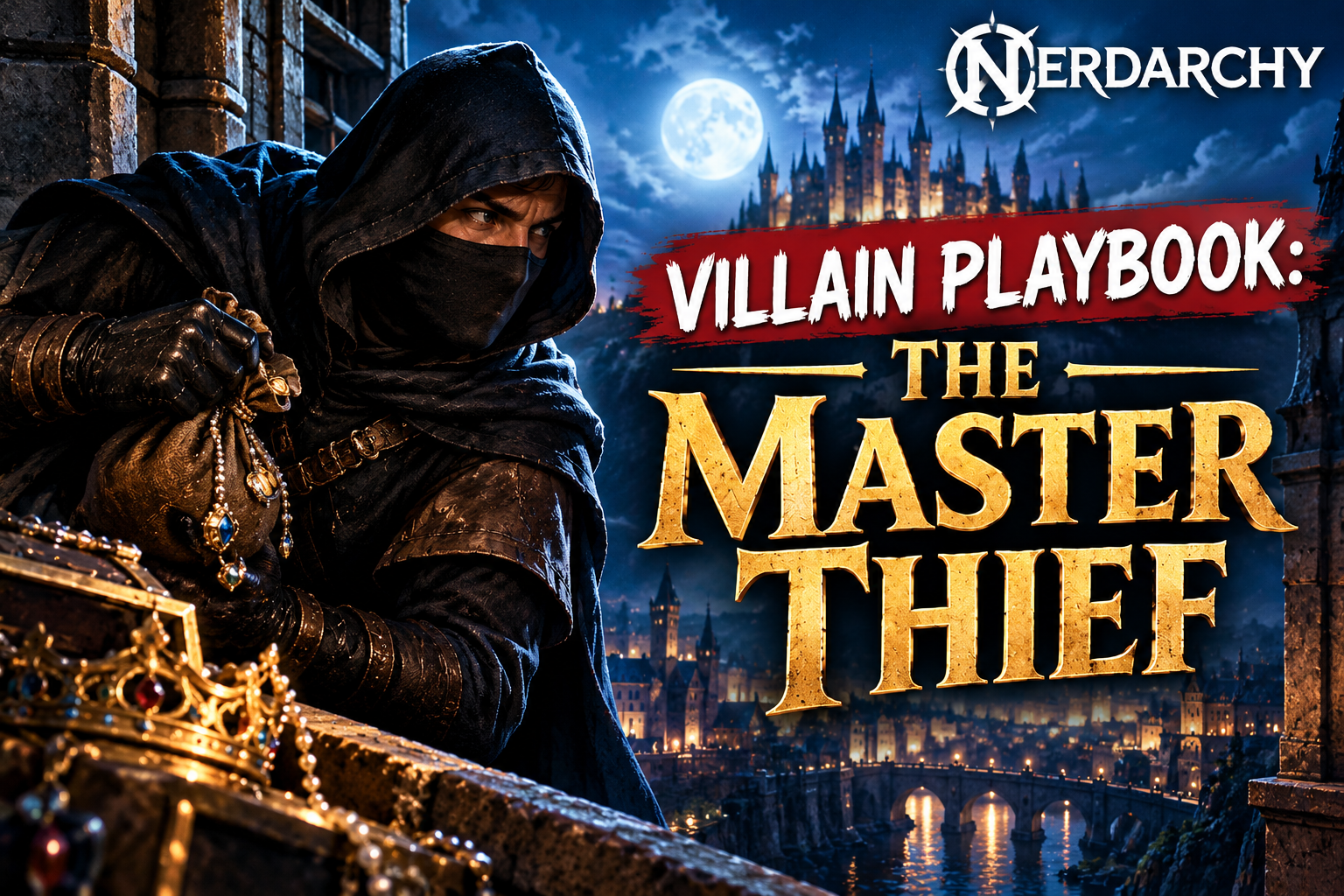
Next time in the Villain Playbook, we’re looking at The Master Thief.
Thanks for reading. Until Next Time, Stay Nerdy!!



No Comments