



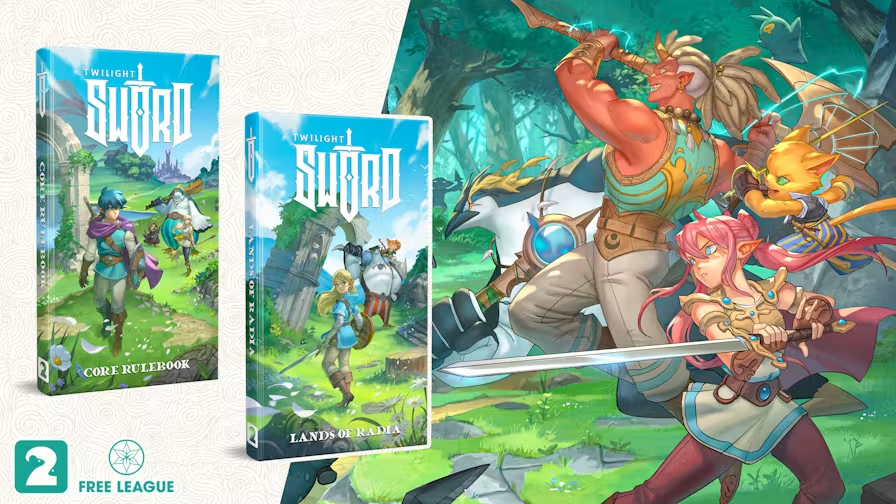
Twilight Sword Review: A World of Hope, Adventure, and Classic Fantasy Video Game Magic
What happens when you take the wonder and exploration of classic fantasy video games, mix in the charm of Studio Ghibli, and turn it all into a tabletop roleplaying game? You get Twilight Sword, an exciting fantasy RPG from Two Little Mice and Free League Publishing that looks like it belongs on the gaming table of anyone who loves adventurous fantasy storytelling.
We recently received a fantastic package from Free League Publishing, including the Twilight Sword Core Rulebook, Lands of Radia, and the Card Chest. First off, a huge thank you to Free League for sending these our way and giving Nerdarchy the opportunity to explore another new tabletop RPG.
There is something immediately appealing about a game that promises exploration, strange creatures, colorful characters, dangerous adventures, and the chance to bring hope back to a world threatened by darkness. And if the inspirations behind Twilight Sword don’t already have your attention, just imagine combining the adventurous spirit of The Legend of Zelda, Dragon Quest, and classic Studio Ghibli films into a tabletop experience.
That’s a pretty enticing recipe for adventure.
Let’s take a look at what arrived and what makes this game worth checking out.
What Is Twilight Sword?

Created by Two Little Mice and published by Free League Publishing
Twilight Sword is an adventure-focused fantasy roleplaying game inspired by classic video games such as The Legend of Zelda, Dragon Quest, and Wonder Boy in Monster Land, along with the animated films of Studio Ghibli.
Those inspirations tell you quite a bit about the experience the designers are aiming for. This isn’t necessarily a grimdark fantasy game where every adventure ends in tragedy. Instead, Twilight Sword embraces exploration, discovery, colorful fantasy, dangerous monsters, memorable characters, and the importance of hope.
Players take on the roles of Champions, heroes awakened to fight against an evil Scourge threatening the lands of Radia. Their ultimate goal is to confront Vardas, the source of the world’s Despair, and bring peace back to the kingdom.
But getting there isn’t simply a matter of marching toward the final villain and swinging a sword. Champions must explore the world, help its inhabitants, overcome dangerous creatures, and gather Hope along the way.
And that last part is one of the things that really makes the premise interesting.
A Different Kind of Fantasy Adventure
One of the central ideas behind Twilight Sword is that Hope is something the characters actively create through their adventures.
Defeating monsters and protecting communities are important, but so are seemingly smaller acts of kindness. Helping someone in need, resolving a personal problem, or bringing happiness back into someone’s life can contribute to restoring Hope.
I love this concept.
Too often, fantasy adventures focus entirely on defeating the villain. The heroes travel from location to location, fight increasingly powerful monsters, collect treasure, and eventually confront the big bad.
Twilight Sword gives players another reason to care about the world.
What happens to the people living in these regions? What have they lost? What can the Champions do to make things better?
That creates opportunities for adventures that aren’t necessarily solved by drawing weapons. Sometimes the most important thing a hero can do is help somebody who has lost their way.
And sometimes, naturally, that hero still needs to defeat a gigantic monster afterward.
How Does the Game Play?
Twilight Sword uses an original system called CAT, or Created at Twilight, built around a straightforward d12 roll-under mechanic.
Characters have eight abilities: Strength, Agility, Vitality, Perception, Will, Knowledge, Charisma, and Stealth. Rather than relying on an extensive list of individual skills, these abilities provide the foundation for resolving challenges.
Players roll a twelve-sided die and generally want to roll equal to or below the relevant ability score. The result is an approachable system that makes it easy to understand what you’re trying to accomplish without constantly looking up complicated modifiers.
Another important resource is Stamina, which gives Champions opportunities to push themselves and make important moments count.
This is an interesting approach because it keeps the focus on what characters are attempting to accomplish rather than burying the table in mechanical details.
For groups that enjoy fast-moving adventures, accessible rules, and plenty of opportunities for imaginative problem-solving, this looks like an appealing foundation.
The game is designed for two to six players, making it a flexible option for different gaming groups.
Free League Publishing+2
The Core Rulebook: Your Gateway to Radia
The Core Rulebook is where everything begins. It contains the rules needed to create Champions, explore the world, fight monsters, and embark on adventures.
Character creation begins with choosing your Kin and Way. The five original Kin offer different approaches to what your character is, while the six Ways establish the direction of your heroic abilities and playstyle. Feats and equipment provide additional opportunities to customize your Champion.
There is plenty here for players who enjoy making characters their own, but the presentation and streamlined mechanics also make the game approachable for people who might not have extensive tabletop RPG experience.
The book also introduces the Lands of Radia, its threats, and the monsters and bosses Champions will encounter.
One thing I particularly appreciate about the overall design philosophy is how the game seems to understand its inspirations. Classic adventure games often give players a relatively simple set of mechanics but surround those mechanics with interesting places, memorable encounters, puzzles, exploration, and opportunities to discover something unexpected.
Twilight Sword appears to embrace that same philosophy.
Lands of Radia: An Entire World to Explore
If the Core Rulebook gives you the tools to become a Champion, Lands of Radia gives you a world worth saving.
This is the first major supplement for Twilight Sword, and it expands considerably on the setting introduced in the core game.
The book provides a richly illustrated guide to Radia, with additional locations, landmarks, important NPCs, quest hooks, monsters, and unique bosses. It also includes additional travel tables to help Game Masters create interesting journeys and unexpected encounters.
That’s a lot of useful material for building adventures.
Travel is one of those things that can sometimes become an afterthought in tabletop RPGs. The party leaves one location, travels to another, and the GM summarizes the journey before getting back to the important stuff.
But exploration should be an important part of the adventure, especially in a game inspired by classic video games.
Think about the memorable journeys in games like Zelda. Discovering a new region, stumbling across a hidden location, meeting an unusual character, or finding something unexpected along the way is often just as entertaining as the major battles.
The additional travel tables and landmarks in Lands of Radia help support that kind of experience.
More Options for Champions
Lands of Radia isn’t exclusively a Game Master resource, either.
The supplement introduces three additional Kin and two additional Ways for players to use when creating their Champions.
That’s always welcome. More character options mean more opportunities for players to find something that excites them, especially when building a group of heroes with different personalities and approaches to adventure.
I also like seeing character options introduced alongside setting material. It creates a connection between the people inhabiting the world and the places where their adventures unfold.
Adventure Hooks Everywhere
The additional NPCs, locations, and quest hooks are particularly useful for Game Masters who want to build a campaign without having to create every single detail themselves.
You can use the material as written, take individual locations and incorporate them into an existing adventure, or use the ideas as inspiration for something completely different.
That’s what I want from a setting supplement.
Give me interesting places, people with problems, mysteries worth investigating, and monsters that make my players nervous.
I’ll take it from there.
The Card Chest: A Treasure Trove of Tabletop Accessories

Now we get to something that immediately caught my attention: the Twilight Sword Card Chest.
This isn’t just a small collection of reference cards. It’s a substantial accessory containing more than 250 cards designed to help players and Game Masters during their adventures.
Inside you’ll find:
-
Monster Cards: Full statistics and artwork for the creatures Champions encounter.
-
Boss Cards: Larger threats with their own dedicated cards.
-
Map Cards: Twenty-five cards that gradually reveal the map of Radia as the characters explore.
-
Weapon and Item Cards: Reference cards for the weapons and equipment available in the game.
-
Kin Cards: Handy references for the different character ancestries.
-
Feat Cards: Character abilities that players can keep close at hand.
-
Spell Cards: Magical abilities ready to reference during play.
Free League Publishing+1
There is something satisfying about having the information you need right there on the table rather than constantly flipping through a rulebook.
Monster cards are particularly useful. A GM can keep the relevant creature information in front of them without needing to bookmark pages or search through a collection of stat blocks.
Players can keep their own abilities, weapons, and spells readily available, making it easier to concentrate on the adventure.
Map Cards Are a Particularly Cool Idea
The twenty-five Map Cards deserve special attention.
The idea of revealing the map of Radia as the characters explore is a fantastic way to reinforce the sense of discovery.
Instead of handing players a complete map of the world and telling them where everything is, the GM can reveal new areas as the Champions travel.
That is a great way to make exploration feel meaningful.
It also creates a nice physical component to the experience. Players can watch the world expand as their adventures progress, gradually piecing together the places they’ve visited and the regions still waiting to be discovered.
I can easily imagine players getting excited when another map card hits the table.
Keeping the Game Moving

I am a big fan of accessories that serve a practical purpose.
Beautiful artwork is great, but if an accessory also helps the game run more smoothly, that’s even better.
The Card Chest seems designed with exactly that in mind.
Rather than simply being a collection of promotional artwork or decorative cards, these are tools intended to see actual use during play.
And having everything organized in a dedicated storage box makes it a nice addition to the overall game collection.
The Artwork and Presentation
One thing that stands out across the Twilight Sword products is the visual presentation.
The game has a distinctive fantasy aesthetic that fits its inspirations beautifully. The artwork helps establish a world that feels magical and adventurous without leaning too heavily into the darker side of traditional fantasy.
That Studio Ghibli influence is particularly appealing.
There is a sense of wonder in the setting, and the illustrations help communicate that. You can imagine strange creatures inhabiting distant regions, unusual characters waiting to offer assistance, and mysterious locations hiding secrets.
The books also use a distinctive compact format, with a tall, narrow page design that creates an interesting presentation when the books are open.
It’s a little different from what many tabletop gamers are accustomed to, but it gives the line its own identity.
Free League and Two Little Mice clearly put considerable attention into the physical presentation of this game.
Who Should Check Out Twilight Sword?
I think there are several audiences who might find something to love here.
If you’re a fan of classic adventure video games, particularly The Legend of Zelda and Dragon Quest, the inspirations behind Twilight Sword should immediately appeal to you.
If you’re looking for a fantasy RPG that’s approachable for newer players, the straightforward d12 system is worth investigating.
If you enjoy exploration, discovering strange creatures, helping memorable NPCs, and uncovering secrets throughout a fantasy world, the Lands of Radia offers plenty of material to work with.
And if you’re a Game Master who appreciates physical accessories, the Card Chest provides some genuinely useful tools for running the game.
I can also see this being an interesting choice for groups looking for a change of pace from more traditional high-fantasy RPG campaigns.
Not every adventure needs to revolve around political intrigue, grim survival, or world-ending threats. Sometimes you want to gather a group of Champions, explore a colorful fantasy world, help people along the way, and have an exciting adventure.
There’s nothing wrong with that.
Final Thoughts: A Promising New Adventure
Twilight Sword looks like a wonderful addition to the tabletop RPG landscape.
The Core Rulebook establishes an accessible system and an exciting premise. Lands of Radia gives Game Masters a much larger world to explore, filled with adventure locations, characters, monsters, and opportunities for storytelling. The Card Chest adds a collection of practical accessories that can make the experience at the table even better.
What I particularly like is that these three products complement one another so well.
The Core Rulebook gives you the rules. Lands of Radia gives you the world. The Card Chest gives you tools to bring that world to life at the table.
And underneath all of it is a game built around something I think is easy to overlook in tabletop RPGs: the idea that being a hero isn’t just about defeating evil. It’s about making the world a better place.
That’s a pretty great foundation for an adventure.
A huge thank you once again to Free League Publishing for sending Nerdarchy the Twilight Sword Core Rulebook, Lands of Radia, and Card Chest. We appreciate the opportunity to explore these products and add another exciting RPG to our gaming collection.
I’m looking forward to seeing what kind of adventures we can create in Radia, what strange creatures our Champions encounter, and how many opportunities we can find to bring Hope back to this world.
If you’re looking for a fantasy RPG with the spirit of classic adventure games, colorful storytelling, exploration, and plenty of opportunities for heroic deeds, Twilight Sword deserves a spot on your radar.
Now, who’s ready to go exploring?
Stay nerdy!



No Comments