




Aether Skies: Designing Sky Leviathans for Epic Encounters
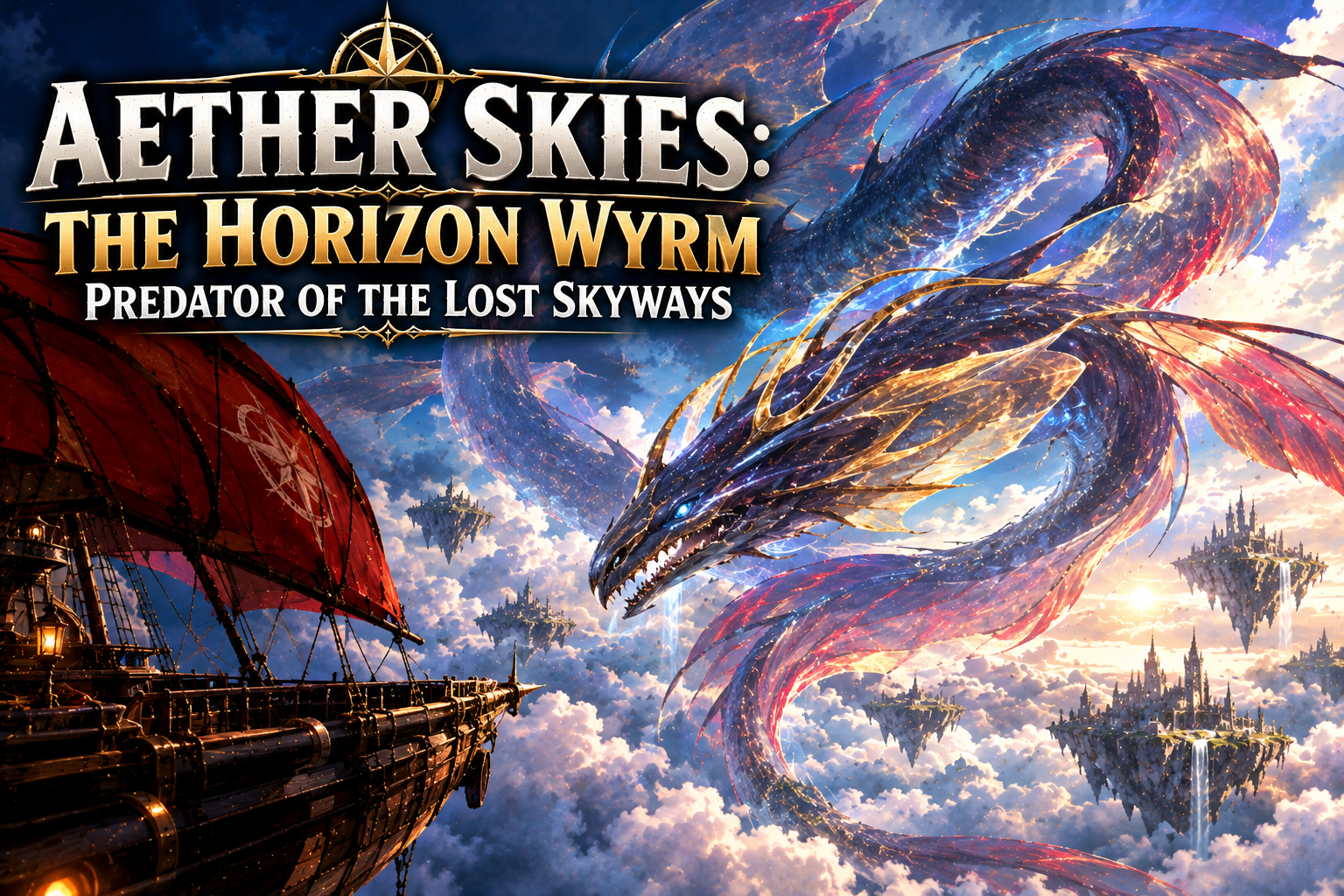
Last week, we explored Aether Skies: 10 Fantastic Creatures That Live Above the Clouds, looking at some of the strange and wonderful creatures that make the skies feel like a living ecosystem. This week, we’re taking that idea to a much larger scale. The skies shouldn’t just have creatures that adventurers encounter along the way. They should have creatures so enormous, ancient and influential that their very existence can shape civilizations.
These are the Sky Leviathans.
A Sky Leviathan isn’t simply a really big monster. Size is only part of what makes one memorable. A great leviathan should feel like something that belongs specifically to Aether Skies, something that could not simply be dropped into an ordinary fantasy setting without losing what makes it special. It should have a relationship with the clouds, aether, airships, floating islands or the civilizations that have learned to live beneath it.
A leviathan can be a terrifying enemy, a source of valuable resources, a living piece of history or even an environmental force that changes the world around it. The best ones can serve several of these purposes at once.
What Makes a Sky Leviathan Different?

The easiest way to design a giant creature is to make it bigger, tougher and more dangerous than everything else. That works for a single encounter, but it doesn’t necessarily make the creature memorable.
Instead, start with a question.
What makes this creature part of the sky?
Perhaps it feeds on aether currents rather than food. Maybe its body generates the clouds surrounding it. Perhaps it carries an entire ecosystem across its back. It could migrate between floating islands according to ancient patterns that nobody fully understands.
The creature’s relationship with the sky should influence its appearance, behavior and abilities. A leviathan that lives inside permanent storms should feel different from one that peacefully travels through the upper atmosphere. One that feeds on airships should behave differently from one that protects them.
This is where a Sky Leviathan becomes more than a monster. It becomes a piece of the setting.
Give Your Leviathan a Signature Feature
Every memorable leviathan needs something players can immediately associate with it.
Maybe the Cloudmother carries enormous forests across her back, creating a floating ecosystem that has existed for centuries. Perhaps the Storm Eater absorbs magical storms into its body, causing entire regions of sky to become unnaturally calm whenever it passes overhead.
A creature could have enormous glowing eyes visible through the clouds long before its body appears. Another might leave behind trails of crystallized aether that become valuable resources for those brave enough to collect them.
The signature feature doesn’t have to be an attack.
It could be something beautiful.
It could be mysterious.
It could even be useful.
The important thing is that when players encounter the creature again, they immediately know what they’re looking at.
Make the Leviathan Part of the Environment

One of the best ways to make a massive creature feel truly enormous is to stop treating it like a creature that simply moves through an environment.
Make it an environment.
Imagine a Sky Leviathan so large that entire communities have built settlements on its back. Forests grow between the ridges of its armored hide. Rivers of condensed cloud flow across its body. Small creatures nest among its spines while adventurers travel from one end of the creature to another without realizing they’re walking across a living being.
Perhaps the leviathan’s movements create weather patterns that affect entire regions. When it dives through the clouds, nearby airships are caught in enormous updrafts. When it becomes agitated, lightning gathers around its body.
Suddenly, encountering the creature isn’t just an encounter.
It’s geography.
Sky Leviathans as Ancient Lore
A leviathan can also become a walking piece of history.
Perhaps the oldest creatures have existed since before the first airship was built. They may have witnessed kingdoms rise and disappear. They could remember when floating islands first separated from the world below or when the first aether storms appeared.
That creates a fascinating possibility for Game Masters: the players don’t always need to fight the leviathan.
They might need to talk to it.
Of course, communicating with a creature that has existed for thousands of years shouldn’t be easy. It might speak through dreams, weather patterns, magical pulses or memories rather than ordinary language.
The creature could know the location of a lost civilization. It might remember the true identity of an ancient ruler. Perhaps it knows why aether storms exist in the first place.
The party may discover that the monster they’ve been searching for is actually one of the oldest historians still alive.
Turn a Leviathan Into a Natural Disaster
Sometimes the most dangerous thing about a Sky Leviathan is that it isn’t interested in the adventurers at all.
Imagine a massive creature migrating directly through a major skyway. Its movement disrupts aether currents, forcing dozens of airships to alter course. Floating islands shake as the creature passes nearby. Clouds become electrically charged.
The players aren’t fighting it.
They’re trying to survive it.
Perhaps their ship has been caught in the creature’s migration path. They need to navigate around its enormous body while avoiding violent atmospheric disturbances. Maybe another vessel isn’t so lucky and becomes trapped beneath one of its wings.
This kind of encounter makes the creature feel appropriately massive. A dragon attacking an airship is a combat encounter. A leviathan whose movement changes the weather around the airship is an event.
Make the Leviathan a Resource

A Sky Leviathan can also provide resources that are important to civilization.
Its naturally shed scales might be stronger than steel. Its bones could be used to construct enormous airship hulls. Its discarded feathers might retain magical properties for centuries. Its blood could contain powerful aether energy.
The key here is making the resource something the creature doesn’t necessarily need to die for.
Perhaps leviathans naturally shed crystal-like scales as they age. Prospectors have become wealthy collecting them. Maybe their molted armor becomes a valuable material for crafting weapons and airship components.
This creates an interesting relationship between civilization and the creatures of the sky.
Not everyone will want to kill the leviathan.
Some people will want to protect it.
Others will want to exploit it.
And some will believe that harvesting anything from such an ancient creature is a form of desecration.
Build Industries Around Your Leviathan
Once a resource becomes valuable, people will build an economy around it.
Imagine an entire community whose livelihood depends on following a migrating leviathan and collecting the resources it naturally leaves behind.
Another settlement might specialize in crafting airship armor from ancient leviathan scales. A wealthy merchant guild could control the trade of these materials. Adventurers might become involved when someone begins illegally harvesting resources from a protected creature.
This is an excellent way to connect your monsters to the broader worldbuilding of Aether Skies.
A creature shouldn’t exist in isolation.
People should have opinions about it.
They should build businesses around it, tell stories about it and argue about what should be done with it.
Give Leviathans Unique Threats
If a Sky Leviathan is going to become an enemy, don’t simply give it a giant pile of hit points.
Give it problems that require the players to think differently.
Perhaps its body generates powerful aether fields that disable normal airship engines. Maybe it can manipulate gravity around itself, causing ships to fall upward or sideways. Another leviathan might generate enormous clouds that make visibility nearly impossible while smaller creatures swarm around it.
A truly memorable encounter should force players to interact with their environment.
They may need to repair damaged engines while the creature circles the ship. They might have to climb onto its back to destroy a parasitic creature controlling it. They could discover that attacking the leviathan directly only makes the situation worse.
The objective doesn’t always need to be kill the monster.
It could be escape it, save it, understand it, drive it away, recover something from it or survive long enough to discover what it wants.
Make the Leviathan a Living Dungeon
Here’s where things can get really strange.
What if the leviathan itself becomes a dungeon?
Its body could contain enormous caverns, ancient scars, magical growths and strange ecosystems. A parasite has burrowed beneath its scales and established a nest. A forgotten civilization has built structures into its body. An ancient artifact is embedded deep within its flesh.
The adventurers don’t necessarily need to kill the creature to explore it.
They could board it.
Climb it.
Travel inside it.
Perhaps they even need to convince the creature to allow them access.
This creates an adventure unlike the traditional dungeon because the entire dungeon is moving through the sky.
Give Your Leviathan a Relationship With Airships

Because this is Aether Skies, the relationship between leviathans and airships should matter.
Some creatures may see airships as prey. Others may consider them annoying pests. A few could be fascinated by them.
Perhaps one ancient leviathan has developed a habit of following certain ships. Captains believe it brings good luck because no vessel followed by the creature has ever been lost.
Another species might instinctively attack airships because they resemble the ancient predators that once hunted them.
Maybe an entire class of specialized airships exists specifically for studying leviathans.
Suddenly, your creature becomes part of the culture of skyfaring.
Create Leviathan Riders
If your world contains enormous creatures, someone will eventually try to ride one.
That could lead to an entirely new culture.
Perhaps a nomadic people travel across the skies on the backs of trained leviathans. Their settlements move with their creatures, following ancient migration routes. They rarely visit conventional sky ports and are considered mysterious by people who live on floating islands.
Maybe they serve as guides through regions where conventional airships cannot safely travel.
Or perhaps they are feared because their leviathans can destroy an entire fleet.
This creates another opportunity to show that the same creature can be viewed completely differently by different cultures.
To one kingdom, the leviathan is a monster.
To another, it is a sacred companion.
Make Their Behavior Predictable
Even the strangest creatures should have patterns.
A leviathan might always migrate north during the first full moon of the year. Another could appear whenever a particular aether storm forms. A third might surface from the clouds every hundred years.
These patterns allow players to learn about the creature.
Once they understand it, they can use that knowledge.
Perhaps the party needs to find a particular leviathan, but the only way to do so is to understand its migration. Maybe an enemy fleet intends to intercept it because they know where it will appear.
The creature’s behavior becomes a puzzle rather than a random encounter.
Let Legends Be Wrong
One of my favorite ways to introduce a leviathan is through conflicting stories.
Sailors claim the creature eats entire airships.
Scholars insist it is harmless.
Merchants claim its scales are worth a fortune.
A religious order believes killing one will bring about the end of the world.
Then the players finally encounter it and discover that every story is partially wrong.
Maybe the creature isn’t aggressive at all. It has simply been defending itself from generations of hunters.
Perhaps the “monster” responsible for destroying ships was actually trying to protect a floating island.
This gives players a chance to become the people who finally uncover the truth.
Sky Leviathans as Campaign-Level Threats
Some leviathans shouldn’t be encounters at all.
They should be campaigns.
Perhaps one enormous creature has begun migrating toward populated regions. Nobody knows why. Governments mobilize fleets to stop it, while scholars argue that killing the creature could have catastrophic consequences for the ecosystem.
Maybe an ancient leviathan awakens after thousands of years beneath the clouds.
Its movements destabilize aether currents.
Floating islands begin drifting.
Storms appear in places where they have never existed.
Airships disappear.
Suddenly, the creature isn’t something the heroes encounter during an adventure.
It is the reason for the adventure.
Use Leviathans as Sources of Mystery
A Sky Leviathan can also be a question rather than an answer.
Where did it come from?
How long has it existed?
Why does it migrate?
What lies inside the enormous crystal growths along its spine?
Why does it react whenever the players use a particular magical artifact?
Perhaps the heroes slowly discover that the creature has been following their adventures for months.
Maybe it isn’t hunting them.
Maybe it is watching them.
That kind of mystery can turn a creature first introduced as a spectacular sight into one of the central figures of an entire campaign.
Make Every Leviathan Tell a Story

The best Sky Leviathans should tell players something about the world.
A scarred creature might reveal the brutality of ancient hunters. A peaceful giant carrying an ecosystem on its back could demonstrate how life has adapted to the skies. A creature covered in aether crystals might reveal something about the origins of magical energy.
Even the way people react to the creature tells a story.
Merchants see profit.
Scholars see knowledge.
Sailors see danger.
Religious leaders see omens.
Adventurers see opportunity.
And the creature itself may see all of them as little more than strange creatures flying around in tiny wooden boxes.
The Sky Is Bigger Than the Airships
Airships are one of the defining features of Aether Skies, but they shouldn’t make the skies feel civilized. If anything, they should reveal how enormous and wild the world really is.
A ship can cross a continent, but a Sky Leviathan may have been traveling that same route for thousands of years.
An airship captain may know every established trade route, but a leviathan may follow paths through the clouds that no map has ever recorded.
That’s what makes these creatures so valuable to the setting.
They remind players that civilization has only recently begun exploring the skies.
The world above the clouds was there first.
Designing Your Own Sky Leviathan
When creating your next giant creature, don’t start with its Challenge Rating or damage output. Start with its story.
Ask what it eats. Ask where it migrates. Ask what happens when it passes through a settlement. Ask what resources it provides. Ask what ancient events it remembers. Ask whether people fear it, worship it, hunt it or protect it.
Then give it one unforgettable feature that makes players recognize it immediately.
A great Sky Leviathan shouldn’t feel like a monster that happens to be flying.
It should feel like the sky itself has come alive.
And once your players see one of these creatures rising through the clouds, blocking out the sun as its enormous silhouette passes overhead, they’ll understand something important about Aether Skies.
The airships may belong to the people who built them.
The skyways may belong to the merchants, pirates and kingdoms fighting for control.
But the skies themselves?
Those have always belonged to the leviathans.
Next week, we’ll take another step toward the practical side of running an Aether Skies campaign with Aether Skies: Airship Combat—Making Battles Above the Clouds Exciting. We’ll look at how to make ship-to-ship battles more than trading attack rolls between two flying vessels and turn them into dynamic encounters where the entire crew has something important to do.
Thanks for reading. Until Next Time, Stay Nerdy!!


No Comments