




The Families That Run the Zoo: Framing a Zoo Mafia Campaign
Every animal in the zoo knows the names.
Some speak them with respect. Others whisper them with fear. A few dream of replacing them.
The families are the true power behind Zoo Mafia. They control territory, shape the flow of information, enforce their own brand of justice, and decide who rises and who disappears. While visitors see exhibits filled with animals, those who live within the underworld see something very different. They see borders, alliances, criminal enterprises, and long-standing rivalries stretching back generations.
For Game Masters and players alike, understanding the families is the key to building memorable Zoo Mafia campaigns. The most compelling stories rarely begin with a heist or a shootout. They begin with competing interests, conflicting loyalties, and ambitious characters trying to survive in a world ruled by powerful organizations.
Before planning adventures, it helps to understand who truly runs the zoo.
The Families Are the Setting
One of the easiest mistakes to make when running a crime-focused campaign is treating criminal organizations as background details.
In Zoo Mafia, the families are not background elements.
They are the setting itself.
Every territory belongs to someone. Every smuggling route is protected by someone. Every rumor, favor, debt, and opportunity can usually be traced back to a family that stands to benefit from it.
The families create the social structure that holds the underworld together. They provide order where chaos might otherwise reign. They establish rules, traditions, and expectations that influence daily life throughout the zoo.
Even animals who want nothing to do with organized crime eventually discover that organized crime wants something to do with them.
The families are everywhere.
Building Distinct Families
The most interesting criminal organizations are rarely distinguished by power alone.
A family becomes memorable when it develops its own identity.
One family might value honor and loyalty above all else. Another may operate as a ruthless business enterprise where profit outweighs personal relationships. A third may thrive on secrets, preferring manipulation and blackmail to direct confrontation.
Species can influence these identities without defining them completely.
A lion-led family may project strength and dominance, but perhaps its true power comes from diplomacy and negotiation. A raccoon syndicate might appear chaotic from the outside while secretly maintaining the most efficient criminal operation in the zoo. A raven crime family could build its empire through information gathering and carefully cultivated secrets.
The goal is not to create stereotypes.
The goal is to create organizations with distinct personalities, motivations, and methods.
Players should immediately recognize when they are dealing with one family versus another.
Power Comes in Many Forms

Not every family controls territory in the same way.
Some dominate through fear.
Others maintain authority through favors and obligations.
Some families have wealth. Others possess information. Some command loyalty while others rely on intimidation.
The strongest campaigns recognize that power takes many forms.
A physically imposing predator may rule an exhibit through reputation alone, while a seemingly insignificant group of rodents quietly controls the movement of information throughout the zoo. One family might own the best smuggling routes while another maintains relationships with nearly every major faction.
These different forms of influence create opportunities for alliances, rivalries, and shifting power dynamics.
No single family should have everything.
That imbalance is what creates drama.
The Best Campaigns Start Small
When many Game Masters begin planning a crime campaign, there is a temptation to focus immediately on the biggest players and the largest conflicts.
Zoo Mafia works best when the story starts at street level.
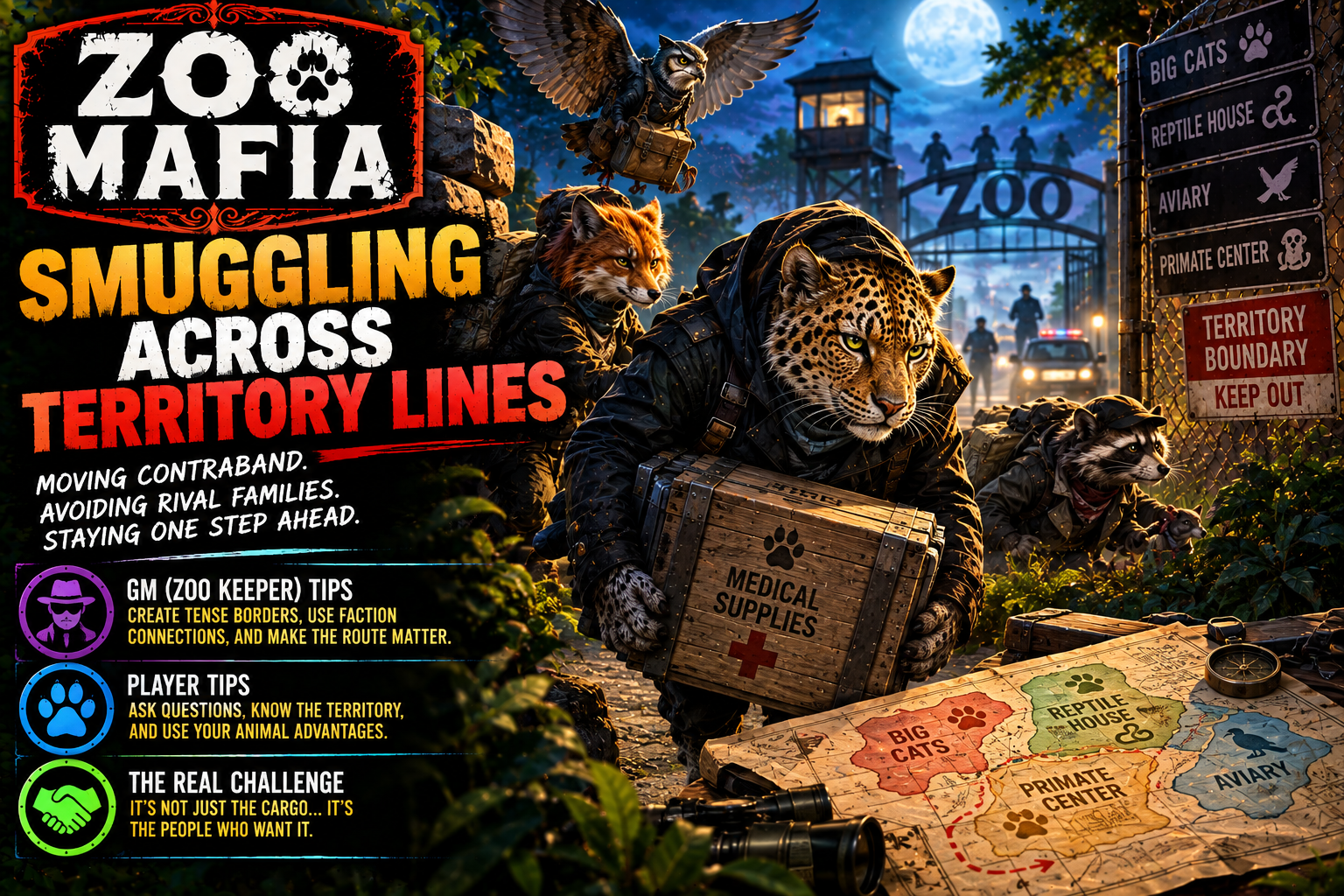
Players should begin by dealing with local problems, small jobs, and manageable threats. Perhaps they are collecting information for a local boss. Maybe they are escorting contraband through disputed territory. They might be trying to recover stolen goods before a family war erupts.
At first, the players see only a small piece of the underworld.
As they gain experience and reputation, they begin discovering how much larger the zoo truly is.
This approach mirrors classic crime fiction. The protagonists rarely understand the full scope of the conspiracy at the beginning. They uncover it gradually, one dangerous revelation at a time.
Framing the Campaign
The most important question for a Zoo Mafia campaign is simple.
Who are the players?
The answer shapes everything that follows.
A campaign centered on ambitious newcomers feels very different from one focused on established enforcers. Independent operators face different challenges than loyal members of a crime family. Characters trying to build an empire create different stories than those attempting to survive someone else’s.
The strongest campaigns establish this identity early.
Players should know how they fit into the underworld and what motivates them to keep moving forward.
The campaign does not need a complicated premise.
It needs a clear one.
Every successful crime story begins with characters who want something.
Power. Respect. Wealth. Revenge. Security. Freedom.
Once those motivations are established, the story begins writing itself.
Campaign Structure Through Seasons

Zoo Mafia naturally lends itself to a seasonal approach.
The first phase of a campaign often focuses on establishing relationships and building reputation. Players learn the rules of the underworld while taking on increasingly dangerous jobs.
The second phase introduces larger conflicts. Rival families become involved. Alliances are tested. Choices begin carrying significant consequences.
The third phase forces the players to decide what kind of criminals they want to become. Are they loyal soldiers, independent operators, rising bosses, or potential revolutionaries?
By the final phase, the players have become influential figures within the zoo. The decisions they made throughout the campaign now determine the future of entire territories and organizations.
The underworld remembers everything.
Success creates new opportunities.
Failure creates new enemies.
Let the Families Evolve
One of the greatest strengths of Zoo Mafia is that the setting should never remain static.
Families grow stronger or weaker. Leaders rise and fall. Alliances form and collapse. Territories change hands. New criminal enterprises emerge while old traditions disappear.
The zoo should feel alive.
When players complete a mission, the world should react. When they make enemies, those enemies should remember. When they help a family gain power, that victory should create ripple effects throughout the setting.
The families are not scenery.
They are active participants in the story.
The more they evolve, the more believable the underworld becomes.
The Zoo Belongs to Someone
Every exhibit has a ruler.
Every territory has a history.
Every family has ambitions that extend beyond its borders.
Understanding these forces is the first step toward creating compelling Zoo Mafia campaigns. The families provide the framework upon which every story is built. They create the conflicts, opportunities, and relationships that transform a collection of animal characters into a living criminal ecosystem.
Because in the end, Zoo Mafia is not just about crime.
It is about power.
And power is always personal.
The question is not whether the families run the zoo.
The question is whether your crew can survive long enough to join them.
Until next time, stay nerdy and keep building unforgettable stories.



No Comments