




Death as a Powerful D&D Entity
Using Inevitability, Compassion, and Cosmic Order in Dungeons & Dragons

A death knight as seen in the fifth edition Dungeons & Dragons Monster Manual. [Image courtesy Wizards of the Coast]
Death does not threaten.
Death does not bargain.
Death does not lie.
Death simply arrives.
Terry Pratchett’s Discworld version of Death is one of the most striking portrayals of the concept in modern fiction—not as a villain, but as a patient, literal, and quietly compassionate cosmic function. Translated into Dungeons & Dragons, Death becomes something far more interesting than a grim reaper stat block.
He becomes inevitability with a conscience.
This article explores how Death from Discworld fits into D&D lore, what kind of entity he would be, and how Dungeon Masters and players can use him to add emotional weight, philosophical depth, and unforgettable moments to their campaigns.
What Type of Creature Would Death Be in D&D?
Creature Type: Cosmic Entity / Psychopomp
Subtype: Neutral Arbiter, Outsider
Power Tier: Lesser Deity or Fundamental Force
Death is not undead.
He is not a fiend.
He is not a god who demands worship.
In D&D terms, Death is best understood as a fundamental force given form—a being that exists because the universe requires him to.
Unlike Archfey or trickster gods, Death:
-
Has a clearly defined role
-
Does not exceed or abuse his authority
-
Cannot be meaningfully opposed
He does not kill.
He collects.
How Death Fits Into D&D Lore
A Universal Constant Across Planes
In a multiverse like D&D’s, Death exists outside alignment conflicts and planar politics.
Possible lore placements:
-
A neutral cosmic arbiter predating the gods
-
The steward of the River of Souls
-
A being acknowledged—but not commanded—by deities
-
A presence that transcends planes, appearing in all of them
Fiends fear him.
Celestials respect him.
Gods do not interfere.
Because even gods die—eventually.
Death’s Defining Trait: Compassion Without Exception

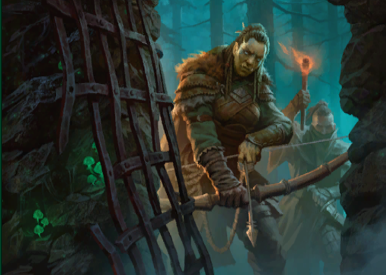
The Kraul death priest as seen in Guildmater’s Guide to Ravnica has death in its name and an array of nasty abilities to bring it to adventurers. [Image courtesy Wizards of the Coast]
Discworld’s Death is not cruel.
He is deeply curious about mortals.
In D&D terms, this makes him terrifying in the quietest possible way.
He:
-
Speaks plainly and literally
-
Never raises his voice
-
Never rushes someone who is not ready
-
Shows kindness without breaking the rules
If a mortal cheats death, it is never because Death failed—it is because something else intervened.
And he remembers.
Powers and Abilities (Narrative-First)
Death’s power should never be expressed in hit points.
Signature traits might include:
-
Inevitable Arrival: Death appears when a soul is due—no spell prevents this
-
Temporal Grace: Can pause time for a dying creature to speak
-
True Sight of the Soul: Sees what a creature is, not what it claims to be
-
Absolute Neutrality: Cannot be persuaded, bribed, or threatened
-
Cosmic Courtesy: Treats all beings with the same calm respect
If combat somehow occurs, it is not a fight.
It is a misunderstanding.
And it ends instantly.
How Dungeon Masters Can Use Death

1. A Moment, Not an Encounter
Death works best when he appears briefly:
-
After a character’s death
-
At the edge of a resurrection attempt
-
During a prophetic vision
He should feel personal, not cinematic.
2. A Tool for Emotional Weight
Death allows DMs to:
-
Honor character sacrifice
-
Give dying NPCs dignity
-
Let players say goodbye properly
He makes death meaningful without being punitive.
3. A Check on Immortality Loops
In high-level play, Death can gently remind players:
-
Resurrection is not free
-
Escaping death repeatedly has consequences
-
The universe notices patterns
Not as punishment—but as balance.
How Players Can Engage With Death
Speak Honestly
Death is not tricked by clever words.
He respects:
-
Honesty
-
Courage
-
Acceptance
Characters who try to manipulate him gain nothing.
Characters who face him truthfully may gain time—or understanding.
Accept That Some Things Cannot Be Won
Death is not a villain to defeat.
He is:
-
A certainty to be acknowledged
-
A boundary that gives life meaning
Players who lean into this often find these moments become the most memorable of the campaign.
Death Compared to Other Mythic Entities

Sure the DM Player Character won’t affected anything.
| Entity | Power Focus | Relationship to Mortals |
|---|---|---|
| Cheshire Cat | Paradox | Mocking guide |
| Goblin King | Desire | Seductive ruler |
| Death | Inevitability | Patient witness |
Together, they form a powerful thematic triangle:
-
The Cat questions meaning
-
The King exploits longing
-
Death reminds us that time is finite
Why Death Belongs in Your D&D Campaign
Death works because he:
-
Respects player agency
-
Adds gravity without cruelty
-
Makes sacrifice matter
-
Treats mortality as sacred, not shameful
In a game about heroism, Death reminds us why heroism matters at all.
Because lives end.
Because choices matter.
Because stories have endings.
And when the time comes—
Death will be there.
Waiting.
Very politely.
Thanks for reading, Until Next Time, Stay Nerdy!!

No Comments